
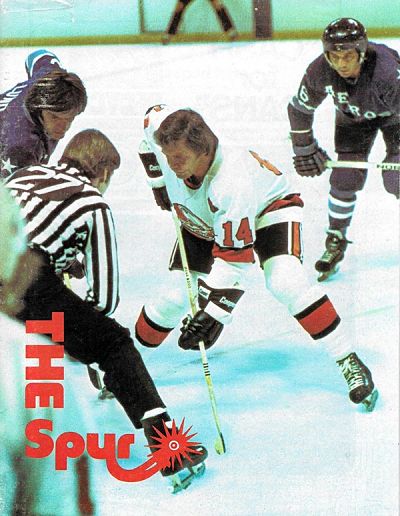
Western Hockey League (1968-1974)
Central Hockey League (1974-1975)
World Hockey Association (1975-1976)
Tombstone
Born: October 15, 19671New Team, UPI via The Bryan Times, Oct. 16, 1967
Moved: January 2, 1976 (Ottawa Civics)2Denver Spurs move to Ottawa, AP via The St. Petersburg Times, Jan. 3, 1976
First Game: October 9, 1968 (L 4-2 vs. San Diego Gulls)
Last Game: December 30, 1975 (W 2-1 vs. Indianapolis Racers)
Lester Patrick Cup Champions (WHL): 1972
Adams Cup Championships (CHL): None
AVCO Cup Championships (WHA): None
Arenas
1968-1975: Denver Coliseum (8,110)31974-75 Denver Spurs Program
Opened: November 7, 19514Denver Coliseum’s glorious history spans music, rodeos, sports and much, much more, The Denver Post, Mar. 9, 2017
1975-1976: McNichols Arena (16,800)51975-76 World Hockey Association Media Guide
Opened: August 22, 1975
Demolished: January, 2000
Marketing
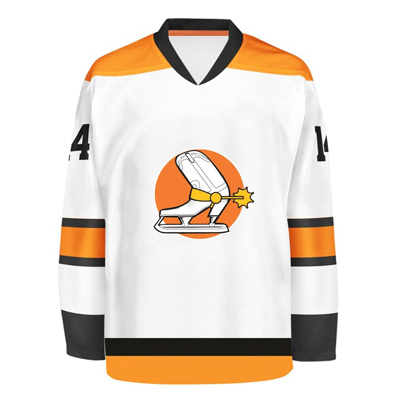
Team Colors: Orange, Black & White61975-76 World Hockey Association Media Guide
Radio:
- 1970-71: KLZ (560 AM)
Radio Broadcasters:
- 1970-71: Bill Bennett
Ownership & Affiliation
Owners:
- 1967-1970: Timothy Collins
- 1970-1971: Bennett King, Rowland Boucher, Henry Candler, et al.7Sports in Brief, S-P Wire Services via The Phoenix, Jul. 2, 1970
- 1971-1972: St. Louis Blues (Sid Salomon Jr., Sid Salomon III & Robert Wolfson)8Denver franchise transferred, AP via The Leader-Post, Apr. 2, 1970
- 1972-1976: Ivan Mullenix9Blues’ Farm Club Will Be Sold, UPI via The St. Joseph News-Press, Aug. 16, 1972
NHL Affiliation
- 1968-1971: Los Angeles Kings
- 1971-1974: St. Louis Blues
Background
The Denver Spurs were a hockey team based in Colorado in the late ‘60s through the mid ‘70s that played in three different leagues during their nearly 10-year history. The club was established by local investment banker Tim Collins in 1967 as a member of the Western Hockey League (WHL). The start of the 1968-69 WHL season marked their debut, returning pro hockey to the Mile High City for the first time since 1964.
In their first season, the Spurs finished last in the six-team circuit, with a record of 23-44-7. The following year, the team skated to a 24-37-11 mark, finishing sixth again, but not in last place as the WHL had grown to seven teams.
Small crowds
Not surprisingly, the two disappointing finishes resulted in sparse crowds at the Denver Coliseum, the team’s home. Discouraged, Collins sold the club to a local syndicate in 1970. The team improved only slightly in their third year, to 25-31-16, but that was good enough for a fourth-place finish and a trip to the playoffs. They lost to the Phoenix Roadrunners 4 games to 1 in the first round.
 The new ownership had even less patience than Mr. Collins, and the debt-ridden team was acquired by the St. Louis Blues in April 1971 and became that NHL team’s farm club. The deeper pockets and bevvy of talented players in their new parent organization were just the tonic for the ailing Spurs. The team finished 44-20-8 en route to capturing the WHL’s Lester Patrick Cup.
Still, the team lost $250,000 during their championship run, and the Blues looked to unload the team. They found a buyer in their own backyard as St. Louis real estate developer Ivan Mullinex bought the Spurs in August 1972. Within two months, the new owner filed a formal application to have the team admitted to the NHL as an expansion franchise.10Denver makes bid for NHL franchise, UPI via The Windsor Star, Oct. 11, 1972
Denver tries had to get into the NHL
It took two more years of lobbying, but finally, on June 13, 1974, the NHL granted a conditional expansion franchise to Denver, along with fellow WHL city Seattle, home of the Totems.11Denver, Seattle Get Franchises In NHL Expansion, The Press-Courier, Jun. 14, 1974 Ivan Mullinex and his Seattle counterpart, Vince Abbey, were charged a $6 million expansion fee. San Diego also applied, but was rejected.
Even though the departure of the Spurs and Totems was two years away, the WHL called it quits, a decision exacerbated by the top-level World Hockey Association (WHA) moving the Jersey Knights to Southern California to become the San Diego Mariners and subsequently leasing that city’s Sports Arena out from under the WHL Gulls. Denver and Seattle, along with the Salt Lake Golden Eagles, moved to the Central Hockey League (CHL) starting with the 1974-75 season, as the former two clubs prepared to move up to the NHL.12NHL Adds Pair Of Teams, Rejects San Diego Bid, AP via The Robesonain, Jun. 13, 1974 The Phoenix Roadrunners had opted to join the WHA before the WHL season had even ended.
Too many pro hockey teams?
When the puck dropped to open the 1974-75 season, there were 32 major league teams, 18 in the NHL, 14 in the WHA. Many of them were in trouble. As such, the NHL became skittish about adding Seattle and Denver, especially as the former struggled to come up with the necessary funds to secure their bid. When it looked like Seattle’s bid was going to be revoked permanently in February 1975, Mullinex joined a queue of folks looking to buy and relocate the troubled Oakland-based California Golden Seals.13Denver takes aim on Seals, AP via The Leader-Post, Feb. 28, 1975 That bid failed, but a month later, Denver got the green light as it was announced the Spurs would begin play in the NHL starting with the 1975-76 season.14Governors decide to let Denver in fold, CP via The Calgary Herald, Mar. 12, 1975
The honeymoon ended quickly, though, as the NHL pushed the Spurs’ debut back to the originally proposed 1976-77 season. Frustrated, Mullinex announced on May 19, 1975, that the Spurs were joining the WHA for the 1975-76 season.15Denver Team Will Enlist In WHA, AP via The Observer-Reporter, May 20, 1975There, they would be reunited with their old WH buddies, the Phoenix Roadrunners. The Cincinnati Stingers debuted that season, having joined the WHA in a fashion not dissimilar to the Spurs.
However, Cincinnati fans were much more excited to have a WHA than the Denver faithful, who had been expecting the NHL and felt betrayed. The Spurs drew barely 4,300 fans per game, while the Stingers pulled in over 7,700.
The end of the Denver Spurs
After just 34 games, the Spurs were no more. On December 30, 1975, they hosted the Indianapolis Racers and won 2-1 in overtime in front of just 3,500 fans in the 16,000-seat McNichols Sports Arena.16Whalers coach stresses defence, CP via The Leader-Post, Dec. 31, 1975 Their next game was scheduled for January 2 in Cincinnati. Before taking the ice, the team stood puzzled as the Canadian national anthem was played in their honor, giving many players their first clue that they were no longer the Denver Spurs but instead had become the Ottawa Civics.
The Civics lasted just over two weeks, as Mullinex tried to find buyers for the team in the Canadians capital, and thought he had found a group willing to buy the franchise.17Ottawa buying Denver Spurs, AP via The Leader-Post, Jan. 5, 1978 When a satisfactory deal could not be worked out, he folded the team. Six months later, the NHL’s Kansas City Scouts moved to Denver and became the Colorado Rockies.18Denver to get NHL franchise, AP via The Star-Phoenix, Jul. 27, 1976
Denver Spurs Shop
Links
##