
World Hockey Association (1975-1979)
Central Hockey League (1979)
Tombstone
Born: May 7, 1973 – WHA expansion franchise1Forum Trumpeter Awaits Canadiens’ Title Clinching, AP via The Toledo Blade, May 8, 1973
Folded: December 18, 19792Cincinnati Loses Hockey Franchise, AP via The Daily Sentinel, Dec. 19, 1979
First Game: October 11, 1975 (W 1-0 @ Cleveland Crusaders)
Last Game: December 18, 1979 (L 10-1 vs. Oklahoma City Stars)
AVCO Cup Championships: None
Adams Cup (CHL) Championships: None
Arena
Riverfront Coliseum (15,820)31975-76 World Hockey Association Media Guide
Opened: September 9, 1975417,000 See Concert in Cincinnati, AP via The Portsmouth Times, Sep. 10, 1975
Marketing
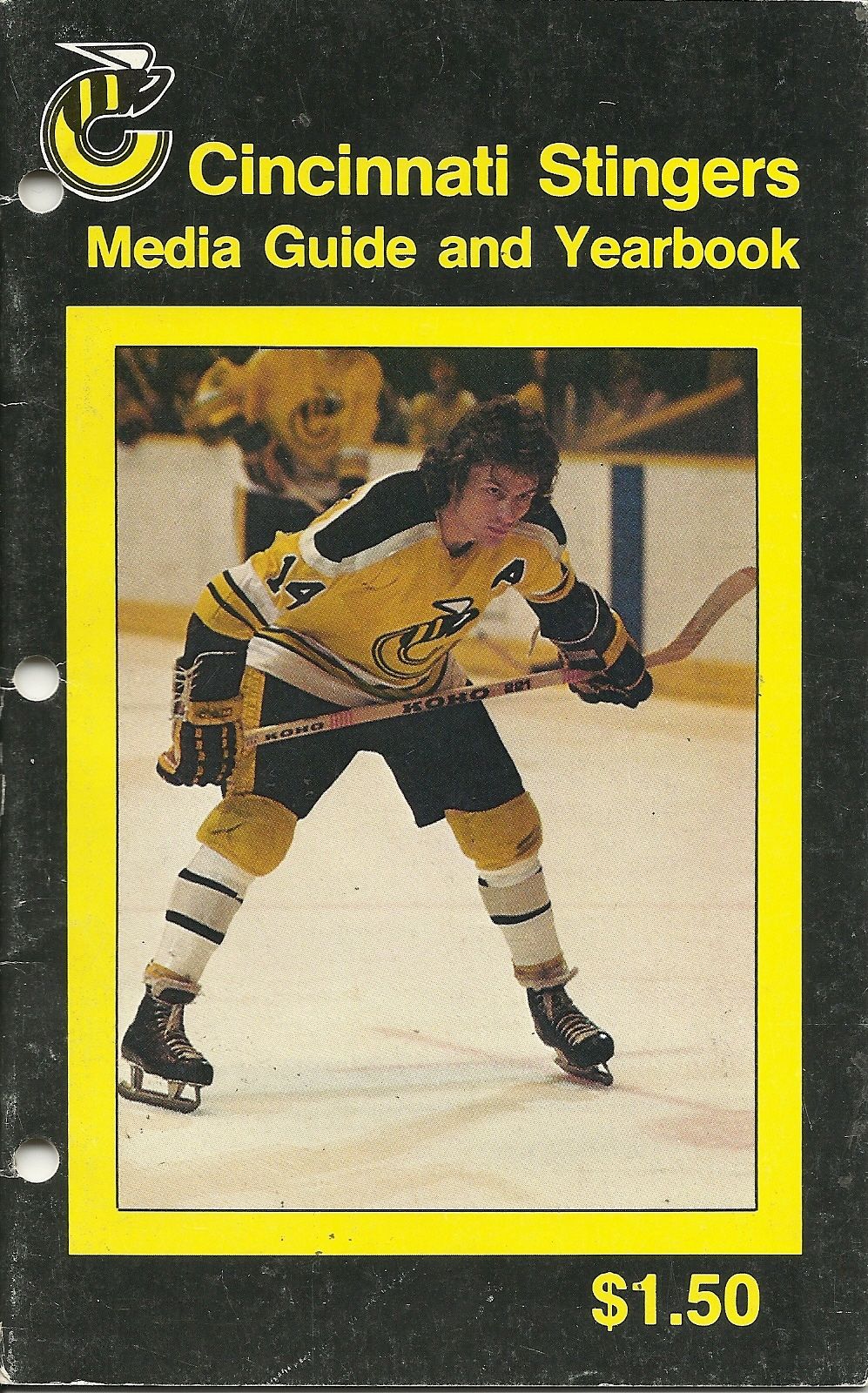
Team Colors: Black, Yellow & White51975-76 World Hockey Association Media Guide
Ownership
Owners:
- 1975-1979: Bill DeWitt Jr. & Brian Heekin
- 1979 (CHL): Peter Pocklington, Howard Baldwin, Carling O’Keefe Brewery, Barry Shenkarow et al.
Background
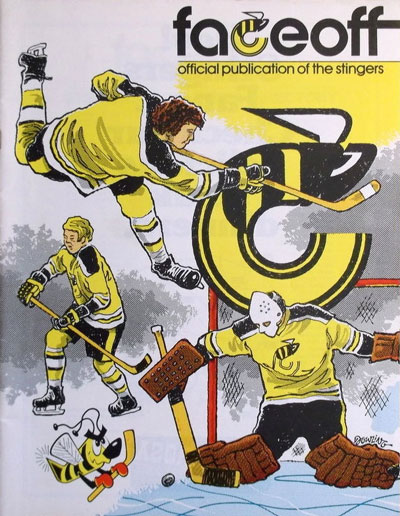
The Cincinnati Stingers were an expansion team in the World Hockey Association (WHA) that began play in 1975. It was Cincinnati’s only major league hockey team and played for four seasons before being left out of the WHA/NHL merger in 1979.
The 1960s and early 1970s were a time of tremendous growth in professional sports. All four major sports leagues were adding teams. In 1967, the National Hockey League (NHL), the smallest of the pro circuits, doubled in size from six to 12 teams. In 1970, two more cities were added as expansion teams were awarded to Vancouver and Buffalo. The latter had been home to a team called the Bisons in the American Hockey League (AHL), which, at the second tier of the sport in North America, functioned as a developmental system for the NHL.
Shuffle off from Buffalo
With Buffalo’s newly minted Sabres in the big leagues, the former Bisons franchise became the NHL team’s minor league affiliate in the AHL and was relocated to Southwest Ohio. There, they were named the Cincinnati Swords and moved into the Cincinnati Gardens. That arena was also the home to the Cincinnati Royals of the National Basketball Association (NBA).
The Swords, owned by the Sabres, were a hit, and bolstered by competitive play on the ice, packed the Gardens with fans. Two of those fans were Bill DeWitt Jr., whose father owned the Cincinnati Reds at that time, and his attorney friend Brian Heekin. After attending several Swords games, they started to wonder if Cincinnati would be able to take it a step further and support an NHL franchise.
“We got interested in hockey because I had seen how well it had done in various cities, particularly St. Louis,” DeWitt told FWiL, “and I thought it would be successful here.”
The NHL in Cincinnati?
The duo soon formed the Cincinnati Hockey Club and proceeded to find out if they were indeed on to something. Their first order of business was securing a home for their proposed team. The Gardens, built in 1949, was still a fine hockey venue, but at 23 years of age, inadequate to woo the NHL, as most of the league’s recently awarded expansion teams were skating in brand-new, state-of-the-art arenas.
DeWitt and Heekin approached the city about building a new arena downtown. On February 25, 1972, the city council agreed to support the idea, provided DeWitt and Heekin could secure an NHL team. “We were required to have a new building,” he explains. “It was a catch twenty-two; without a franchise, it was hard to build an arena, but you couldn’t get a franchise unless you had a building.”
The two confirmed they were focused on bringing the NHL to town, and not a franchise in the newly-announced World Hockey Association (WHA). The WHA had been formed on September 13, 1971 as a rival to the NHL and was set to open for business in the fall of 1972.6WHA Comes Into Existence: Newly-formed circuit threatens NHL, NYTS via The Star-Phoenix, Sep. 14, 1971 It was formed by the same group of sports entrepreneurs who had organized the American Basketball Association (ABA) in 1967 to compete with the established NBA.
 Cincinnati city leaders took DeWitt and Heeking seriously. So much so that the city council approved their bid to have an arena built downtown next to the, then, brand new Riverfront Stadium.7Planners Of Arena Get Go-Ahead In Cincinnati, AP via The Portsmouth Times, Feb. 25,1972.
Less than two weeks later, on March 9, 1972, the Cincinnati Hockey Club officially filed its bid with the NHL to bring an expansion franchise to Cincinnati.8List Growing In Expansion Club Bidding, AP via The Sarasota, Mar. 9, 1972 Ten other cities did the same, including Kansas City, Missouri. Ironically, just five days after the bids were submitted to the NHL, the NBA Royals announced they were leaving the Queen City for Kansas City.9Cincinnati Royals Seek New Life Kanas City, AP via The Sarasota Herald-Tribune, Mar. 15, 1972
Double crossed
Though they were impressed with the Cincinnati group’s presentation, though, the NHL awarded its next two expansion teams to Washington, D.C., and Kansas City on June 8 of that year. Cincinnati, though, was next in line as NHL president Clarence Campbell announced a “definite commitment” to Cincinnati for 1973, provided the ownership group remained intact.10Set for next expansion, NHL to Cincinnati, The Windsor Star, Aug. 25, 1972 A few months later, Kansas City’s bid was in peril, as voters there rejected a plan that would have seen taxpayers foot the bill for a new arena in suburban Overland Park.
As the effort to land an NHL team for the city dragged on, and after Kansas City finally had its bid confirmed by the league, the patience of the Cincinnati Hockey Club was wearing thin, even more so after Indianapolis emerged as a possible NHL expansion location. Though they had previously stated they had no interest in joining the rival WHA, DeWitt, nonetheless, met with the rebel league’s top officials in April 1973.
Cincinnati joins the WHA
As late as May 4 of that year, the Cincinnati Hockey Club was hoping to get a deal with the NHL finalized. But on May 7, the WHA announced that Cincinnati would be joining their league starting with the 1975-76 season.11Sports Whirl, AP via The Virgin Islands Daily News, Mar. 8, 1973 The decision by DeWitt and Heekin to join the WHA had actually been made a month and a half earlier, when the NHL formally approved Kansas City’s application, Brian Heekin told the Associated Press.12Cincinnati waits, finally joins WHA, AP via The Leader-Post, May 8, 1973 He further explained that Cincinnati had been promised a franchise by the NHL board of governors, but at the league’s meetings in Montreal, they reneged, saying they had only promised to keep Cincinnati under consideration.
 “That was the turning point,” he stated to the press. Joining the WHA was cheaper too. The group paid $2 million to join the rebel league, where membership in the NHL would have cost three times that.13Cincinnati waits, finally joins WHA, AP via The Leader-Post, May 8, 1973 “We are now looking for people to set up the franchise and run the team,” he told reporters. Meanwhile, in Bond Hill, the Swords announced that they had no plans to leave the market and would continue to play at the Cincinnati Gardens.14Cincinnati waits, finally joins WHA, AP via The Leader-Post, May 8, 1973
Sadly, the Kansas City Scouts skated for only two years before a lack of money, talent, and fan support forced them to relocate. Local hockey historian Don Helbig maintains that had the Cincinnati Hockey Club not joined the NHL, the Scouts would have moved here in 1976 instead of Denver (and later New Jersey). “The NHL had this market pegged as a future site,” he notes. “Had the WHA Stingers not come about in 1975, the Scouts would have become Cincinnati’s NHL team. No doubt about it.”
New arena moves forward
The fact that the Queen City’s new pro hockey team would be playing in the WHA didn’t seem to dampen the enthusiasm of Cincinnati City Council, though, as plans for the new arena continued. However, the CHC had a change of heart about building the arena in the city, instead choosing a site in suburban Mason near the new Kings Island amusement park. City officials and potential investors, including several local banks, lured them back to downtown Cincinnati. Then, a month later, the deal fell apart as the five local banks involved all pulled out.15Sports Arena Hits Major Roadblock, AP via The Portsmouth Times, Jun. 12,1973
Negotiations continued through the summer, with Heekin and DeWitt telling the press they would simply move the franchise to another city if the arena wasn’t built. Finally, in August, a deal was in place, and though it wasn’t finalized for several months, the ceremonial turning of shovels took place on November 12, 1973.16Cincinnati Begin Huge Coliseum, UPI via The Middlesboro Daily News, Nov. 13, 1973
Team name and colors announced
On Wednesday, March 13, 1974, the team’s name and colors were announced. The team would be known as the Cincinnati Stingers and skate in black, yellow, and white uniforms.17Ciny’s WHA Club Called Stingers, AP via The Schenectady Gazette, Mar. 7, 1974The Stingers built their roster and assigned players to their minor league affiliate, the Hampton Gulls of the Southern Hockey League, in preparation for the start of the 1975 season.18WHA Racers Drop Locas, AP via The St. Joseph News-Press, Feb. 12, 1975
Riverfront Coliseum opened on September 9, 1975, not with a hockey game but a sold-out concert by the Allman Brothers. The Stingers hit the ice for the first time on October 11, 1975, against the Cleveland Crusaders at the Richfield Coliseum in Northeast Ohio. The Stingers beat their cross-state rivals 1-0. After three more games on the road, the home opener took place on October 23, 1975, a 6-4 win against the Edmonton Oilers in front of just over 10,000 fans.19WHA Champs Surprised, AP via The Robesonian, Oct. 24, 197520Racers snap losing streak with shutout of Aeros, CP via The Leader-Post, Oct. 24, 1975
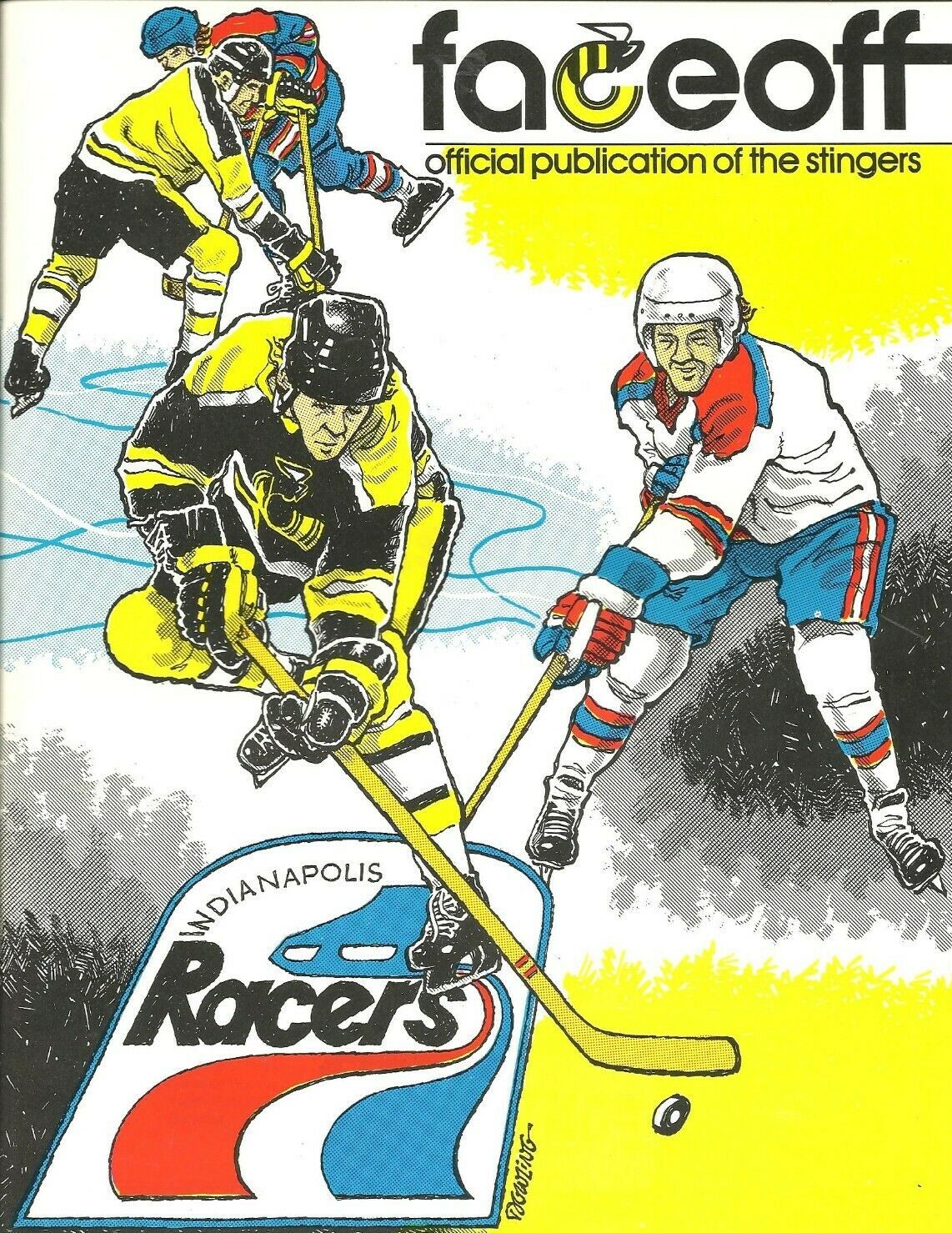
The Stingers finished their inaugural season with 35 wins against 44 losses and one tie. The following season, though, they improved just enough, at 39-37-5, to make the playoffs. Unfortunately, they lost to the Indianapolis Racers in the first round. In those first two seasons, the Stingers averaged around 7,700 fans a game.
NHL/WHA merger talks
As early as 1973, shortly after the end of the WHA’s first season, merger talks with the NHL were floated but summarily rejected by the established league but were quickly rejected by the established league.21NHL rejects merger, CP via The Phoenix, Apr. 19, 1973 Rumors of such an arrangement continued to swirl for years. It was in March 1977, though, in the midst of the Stingers’ second campaign, that serious talks began. In June, Bill De Witt told UPI, “This is an historic step and a great step towards getting the major league hockey situation resolved.” The article in which he is quoted identified the Stingers as one of the WHA’s strongest teams and a “prime candidate to join the NHL if a merger came about.”
On August 4, 1977, the Stingers, along with six other clubs, applied for NHL membership via a merger.22Five WHA clubs bid for NHL, AP via The Montreal Gazette, Apr. 5, 1977 Five days later, NHL commissioner John Ziegler announced the rejection of the proposal. DeWitt was incensed. “There is no way I would recommend to my board of directors that the Cincinnati Stingers ever again apply for a National Hockey League franchise,” he told UPI.23NHL votes ‘No,” merger dead, The Montreal Gazette, Aug. 10, 197724Merger denial angers WHA, UPI via The Ellensburg Daily Record, Aug. 10, 1977
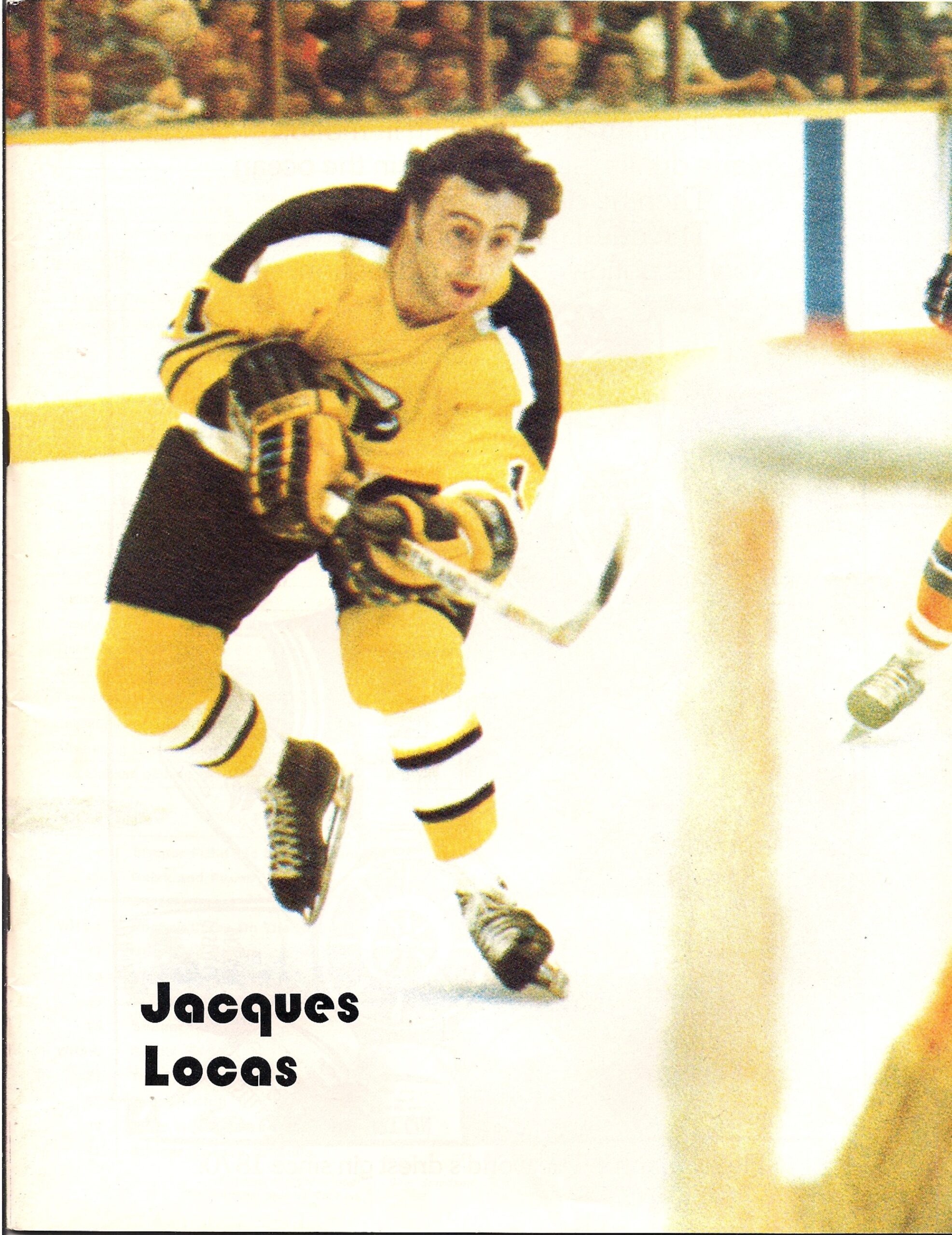 The WHA, along with the Stingers, skated on into the 1977-78 season, where they finished with a record of 35-42-3. By this time, the club was brimming with talent, including future NHL stars Mark Messier, Robbie Ftorek, Mike Gartner, Rick Dudley, and Mile Liut. “The best part about the WHA for me was when I got to Cincinnati, Rick Dudley was there,” Liut says, “and he was a huge influence in so many ways. He took a shine to us college kids. He was very supportive and a very good leader, and he was as tough as anybody in either league.” However, despite all that talent, they did not qualify for the 1978 playoffs.
Merger talks between the two leagues continued, and in February, with the Stingers still in the mix, before another deal fell through. In late spring of 1978, the team mounted a ticket drive in order to stay in business. On June 1, DeWitt told the press the club had sold 5,000 season tickets and would indeed compete in the WHA’s 1978-79 season. It would be the league’s last.25Stingers Ready To Return To Ice, AP via The Portsmouth Times, Jun. 2, 1978
No NHL for Cincinnati
On the ice, the Stingers bounced back with a record of 33-41-6, which earned them a trip to the post season. There, they faced the New England Whalers in the first round but were eliminated two games to one. The Stingers were all but finished a few weeks prior, though, as on March 30, 1979, it was announced that the WHA’s Edmonton Oilers, Winnipeg Jets, Quebec Nordiques, and New England Whalers would be joining the NHL, essentially as expansion teams, for the 1979-80 season.26NHL-WHA Ends Hockey War, UPI via The Pittsburgh Press, Mar. 31, 1979 The Stingers, along with the Birmingham Bulls, would be paid to fold their organizations.
Why the Stingers were left out of the merger has been a source of wonderment for area hockey fans for years, but the reason was very simple: The numbers just didn’t add up.
“We were doing okay but not great,” DeWitt recalls, “and the NHL had their idea of what teams they wanted in. We really weren’t sure at that point how successful it would be, and they weren’t sure either.” It all came down to dollars and cents. The WHA teams that were admitted to the NHL had to pay an expansion fee of $6 million. “We were interested, but I don’t think at that point we were all in.”
The Stingers’ ownership group took the payout and folded the franchise. Liut remembers a team meeting held on the ice at Riverfront Coliseum after the announcement was made. “It was announced Cincinnati wasn’t part of it and (head coach) Floyd (Smith) had a simple message: ‘It doesn’t matter who is in and who is out. All of that is just noise. Whether this team is in or out doesn’t matter. The question is, are you in?’” In other words, the Stingers players, in their final games, would be auditioning for spots on NHL rosters.
After the WHA
However, the Stingers didn’t disappear entirely. Instead, a new version of the club was formed and placed in the minor league Central Hockey League (CHL). The surviving WHA clubs, now in the NHL, owned the franchise and used it as a combined farm team. Local fans could not have been less interested. The club lasted only 33 games before folding in December of 1979.27Cincinnati loses hockey franchise, AP via The Daily Sentinel, Dec. 19, 1979
Hockey returned briefly in 1981 when the Toronto Maple Leafs placed a CHL team in the Queen City and named them the Cincinnati Tigers.28Leafs add Cincinnati affiliate, S-P Services via The Star-Phoenix, Jun. 24, 1981 Poor attendance caused that squad to fold after just one season. The city was without a hockey team until 1990, and the debut of the first iteration of the Cincinnati Cyclones of the East Coast Hockey League (ECHL).
Cincinnati Stingers Shop


In Memoriam
Goaltender Serge Aubry (’75-’76) died of complications from diabetes on October 30, 2011 at age 69.
Acknowledgements and notes:
Special thanks to Cincinnati hockey historian (and theme park expert) Don Helbig, the St. Louis Cardinals media team and team owner Bill DeWitt, comedian Gabe Kea (and his mum), and former Stinger, St. Louis Blues, and BGSU Falcons great Mike Liut.
FWiL founder and former editor-in-chief Andrew Crossley wrote the site’s original post about the Stingers. The post above was originally supposed to appear in Cincinnati Magazine but was never used. For Andrew’s original post click HERE .
Links
##
8 Responses
Dear Mr Crossley:
I am trying to track down the date that Team USA beat the Stingers in 1979.
Can you help me with this or tell me where I can look?
Thank you.
Joe Corr
The WHA Stingers last game was pn 4/24/79, against the New England Whalers. The Whalers won 2-1
I have a lot of stingers memorabilia ticket stubs hockey Time magazine buttons and something else I can think of oh yeah letter heads I’m not a hockey fan so I’m not attached to these things but I would like to get them to fans of the team they are for sale but I’m not picturing to make a bunch of money I just don’t want the things to get lost when some people would have great joy possessing them
Do you still have any stinger stuff available
Do you still have your Stingers stuff for sell ?
I am the WHA historian and interested in the Stingers stuff.
Thanks, Alex
For Joe Corr
I was at that game and still have the ticket stub.
Wednesday November 14, 1979
US Olympic Team 3 Stingers 2 overtime
I can send you a image of the ticket stub if interested
know you posted this awhile ago but I just read it on 4-10-20
I was a teenager during the Stingers’ life. I’m 61 now. I LOVED the Stingers (AND the Honey Bees! ) I still have 3 programs, 1 of which is autographed by all the Honey Bees, ticket stubs, a pennant, and a puck. Going to those games was a blast! I used to look up at the group suites in the Coliseum and think “That’s the life! Thats where I wanna be!” I couldn’t afford a jersey then and would have outgrown it anyway. I had a replica but sold it. I want to get another but they’re all mad in China and I don’t want to pay donald tRUMP’s ILLEGAL tariff. The coliseum was great when it was built and am surprised now, 50 years later, that it is still standing! The Cyclones games are nice but not like the Stingers games! STINGERS FOREVER! Kevin in Cincinnati