All-America Football Conference (1946-1949)

Tombstone

Formed: September 2,  19441All-America Pro Grid Loop Enrolls Seven Clubs With Rich Backing, UP via The Pittsburgh PressSep. 3, 1944
Merger with NFL Announced: December 9, 19492Professional Grid Leagues Finally Agree on Peace, UP via The Bulletin, Dec. 10, 1949
Disbanded: Following league All-Star game on December 17, 1949

First Game: September 6, 1946 (Miami Seahawks 0 @ Cleveland Browns 44)
Last Game: December 17, 1949 (AAFC All-Stars 12 vs. Cleveland Browns 7, Shamrock Bowl/All-Star Game, Houston, TX)3All-Stars Beat Cleveland 12 to 7, UP via The St. Petersburg TimesDec. 18, 1949

Seasons: 4
States : 6
(CA, FL, IL, MD, NY, OH)

Leadership

Commissioner:

1946: Jim Crowley
1947-1948: Jonas Ingram
1949: Oliver Kessing

Trophy Case

Background

The All-America Football Conference (AAFC) was a football league established in 1944 by Chicago Tribune sports editor Arch Wald. He announced its formation at a press conference on September 2, 1944. Two months later, the league named former Notre Dame football star Jim Crowley, one of the famed Four Horsemen, as its commissioner.4Crowley To Be Czar Of Pro Football, UP via The Berkeley Gazette, Nov. 22, 1944His former teammate Elmer Layden held the same position in the established National Football League (NFL).

Jump to franchise list

The AAFC’s plan was to create a structure like Major League Baseball, where two leagues existed separately and then met at the end of the season for a big championship game. The NFL was not keen on this idea at all. When asked about the AAFC’s formation, Layden famously quipped, “Let them get a ball first.”5All-America Conference Prepares for Pro Grid “Battle,” AP via The Youngstown Vindicator, Apr. 22, 1945
When the U.S. entered World War II, the NFL was wrapping up the 1941 season and boasted 10 teams in eight markets. The league did the same in 1942, but by 1943, with the war raging on, it became increasingly difficult to keep teams stocked with healthy, able-bodied players. While Major League Baseball resorted to fielding teenagers and others who might not have otherwise qualified to play at the pro level, the NFL, by the very nature of its game, did not have that option.
For the 1943 season, the league reduced to eight teams, as the Cleveland Rams took the year off and the Eagles and Steelers temporarily merged.6Eight Teams Set To Play In Pro Loop, AP via The Reading Eagle, Jun. 20, 1943 In 1944, the Rams returned, the Steelers hooked up with the Cardinals, and an expansion franchise, the Boston Yanks, was awarded.
Three months before the start of that season, Allied forces in Europe began the D-Day invasion, turning the tide of the war, though it was slow going. As such, the AAFC delayed its proposed kickoff of fall 1945 to 1946. In the meantime, other folks got the notion to start a new football league.

The USFL announced (not THAT USFL)

Five months before Ward’s introductory press conference, a move was already afoot to establish a new pro football league. On March 6, 1944, the Pittsburgh Post-Gazette reported that a group of businessmen had met in that city to discuss the formation of a new circuit, with an official announcement to come “within 30 days.”7Movement Started For New Grid Loop, UP via The VindicatorMar. 6,1944
​It took a little longer than that, but on July 24, the United States Football League (USFL), not to be confused with the popular USFL from the mid-80s, was officially announced.8U.S. Grid League Planned for ’45, UP via The BulletinJul. 24, 1944 Franchises were issued to Akron, Baltimore, Boston, Cincinnati, Honolulu, New York, Philadelphia, Pittsburgh, and St. Louis. It was also reported that all teams would travel to away games via airplane. On November 27, football legend Red Grange was named league president.9Grange to Head Payne’s Pro Loop, UP via The Pittsburgh PressNov. 24, 1944

American Professional Football League

Out west, where two high-level minor leagues operated, a top-tier professional league was announced at the end of June 1944. Bill Freelove, owner of the Los Angeles Mustangs of the Pacific Coast Professional Football League, introduced his new major league, the American Professional Football League (APFL). His plan was to have teams in Hollywood, Los Angeles (two, including his Mustangs), Oakland, Portland, San Diego, San Francisco, and Seattle. An arrangement was later made to pull in and “promote” teams from the minor league PCPFL, but by spring 1945 the APFL had been scuttled, with the PCPFL continuing on as a minor league circuit through 1948.

Trans-America Football League formed.

Just over two weeks after Arch Wald officially announced the AAFC, and two months after the USFL’s launch, along came the Trans-America Football League (TAFL).10Another Pro Grid League Is Organized, UP via the Berkeley Daily Gazette, Sep. 19, 1944The new league was scheduled to begin play “as soon as war conditions permit,” its organizers told the press. Baltimore, Dallas, Houston, Los Angeles, New York, and Philadelphia were announced as participating cities. Denver and Omaha were also eyed, but the latter dropped out when University of Nebraska alumni objected to having a pro team in their state.11Sports Roundup, The Times DailyOct. 4, 1944
The TFA felt quite good about its chances of competing against the NFL in the fall of 1946 and felt quite superior to the AAFC in that regard, at least according to league head Chick Meehan. Indeed, he was very confident that the TFA’s New York franchise would be playing in Yankee Stadium, which would have been a huge coup.

The best of plans mislaid

While boasting about his league to the press, Meehan stated that if the TFA’s New York entry could not secure Yankee Stadium, he would scuttle the entire loop. He also floated the idea of the five wealthiest TFA teams coming into the NFL and making that a 16-team league.12Pro Grid Chiefs Start Parley, UP via the Toledo Blade, Apr. 4, 1945The NFL, though, had just finished fighting for its very existence through the war years, and was not anxious to share its spoils with anyone, internally or externally. To that end, the NFL attempted to lockdown Yankee Stadium for itself, which caused quite a bit of internal strife.
As World War II dragged to a close, the NFL continued to have trouble finding players, and while attendance was solid for most teams, several were experiencing severe financial pressures. The Steelers and Cardinals, who had merged for the 1944 season, were back out on their own. However, the Brooklyn Tigers (formerly Dodgers) merged with the Boston Yanks. Brooklyn owner Dan Topping, part owner of baseball’s New York Yankees, desperately wanted his team to play in Yankee Stadium, but football Giants owner Tim Mara, whose team played at the Polo Grounds in Upper Manhattan, put the kibosh on that idea.
Instead, the merged team was scheduled to play one home game in Yankee Stadium– against the Giants. In June of 1945, the NFL announced that the Brooklyn Tigers would be playing full-time in Yankee Stadium, starting in 1946. This, however, seems to have been a ploy by the NFL to thwart the three upstart leagues. Branch Rickey had given the Tigers the boot from Ebbetts Field, likely because he was thinking of getting into professional football at some point (which he later did). The Giants, of course, had the Polo Grounds, leaving Yankee Stadium as the only other viable venue. With the NFL placing a team there for the 1946 season and beyond, the TFA and USFL would have no real foothold in the nation’s biggest media market. Both subsequently pulled the plug.13Two More Pro Grid Loops Give Up Ship, The Windsor Daily StarJun. 5, 194514All-America Pro Grid Loop Left To Oppose National, UP via The Daily TimesJun. 4, 1945

Then there were two

​The AAFC, though, said it would continue on, regardless of the stadium situation in New York. Then, something interesting happened. After the TFA and USFL ended their efforts, it was revealed that Tim Mara still had not given his blessing for the Tigers to play in Yankee Stadium. Then, in October, Rickey granted a lease at Ebbets field to the AAFC’s New York franchise, which then transferred to Brooklyn and assumed the Dodgers nickname.
The new league’s membership had been sorted by the end of 1944, with only the New York area teams not settled. Through the winter and into spring of 1945, the AAFC had been courting Topping in an attempt to bring him into their operation and secure Yankee Stadium. However, in April, his team’s GM, Tom Gallery, told reporters that the Dodgers would not be joining the new loop. When it looked like only one AAFC team would be playing in the New York area, a group from Kansas City submitted a bid for a franchise and the league’s final spot.15Kansas City to Bid for Pro Grid League Berth, UP via the St, Joseph News-Press, Apr. 20, 1945 The AAFC, though, determined Kansas City was too small to support a pro football team.16Kansas City Not To Have Pro Grid Club, INS via San Jose NewsAug. 30, 1945
Topping continued trying to convince Mara to let his Tigers play in the world’s most famous ballpark, but to no avail.17Mara-Topping Rivalry Widens Gotham Gate For New Pro Grid Loop, The Pittsburgh PressAug. 7, 1945 Fed up, he announced on December 5, 1945, his Brooklyn franchise, now separated from the Boston Yanks, was leaving the NFL to join the AAFC and become the New York Football Yankees, with home games played in the venue he so coveted for his team. This was a major blow to the NFL and showed the AAFC meant business. The AAFC finally had its eight-team circuit assembled: Brooklyn, Buffalo, Chicago, Cleveland, Los Angeles, Miami, New York, and San Francisco.

1946

The AAFC, football in hand, kicked off its first regular season on September 6, 1946, at Municipal Stadium on the shores of Lake Erie in Cleveland, Ohio. The last pro football game to be played in that stadium was the NFL Championship, which had taken place a little less than nine months earlier. The Cleveland Rams defeated the Washington Redskins 15-14 in front of just 32,000 fans in that matchup. The Rams announced their move to L.A. a month later.
The pro football vacuum in Cleveland was soon sealed by taxi cab company owner Arthur “Mickey” McBride, who had acquired an AAFC franchise for the city. He actually closed the deal in September 1944 while the Rams were still in town. McBride was keen to challenge the NFL team he tried to buy in 1941 but ultimately would not get the chance to do so.
Though fan interest had waned on the Rams, McBride stoked interest in his new AAFC club by hiring Paul Brown as its head coach. Brown was a popular figure in Northeast Ohio, having coached the Massillon High School football team as well as at Ohio State. He was coaching at the Great Lakes Naval Station when he accepted McBride’s offer.
It is widely believed the team is named after Brown, but it is not, even though it is. When it came time to name the team, fans chose the nickname Browns. The coach, flattered, rejected the name. Fans then suggested Panthers after the city’s entry in the first American Football League. However, that team was not very successful, and Brown rejected that name as well. After some back and forth, Browns was chosen, with the story being the name was inspired by championship boxer Joe Louis, the “Brown Bomber,” which of course was a bunch of jive, as the popular pugilist had absolutely no connection to Cleveland.
Paul Brown had more pressing concerns and just went with the nickname the fans wanted. His focus paid off as the Browns debuted with a 44-0 shellacking of the Miami Seahawks before a crowd of over 61,000. That game pretty much set the tone for the AAFC’s four-year existence.
Brown and his team brought many innovations to the game, which included the messenger guard, expanded use of the forward pass, and, most importantly, breaking pro football’s color barrier with the signings of Bill Willis and Marion Motley.
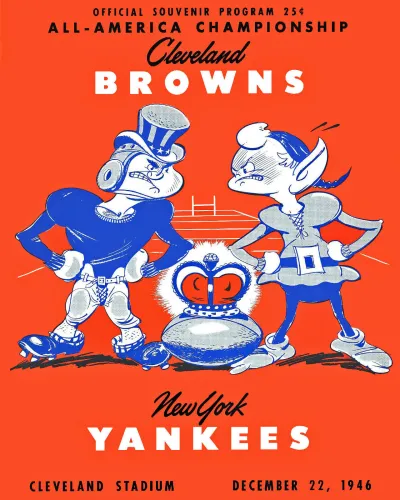
Cleveland marched to a 12-2 record and the AAFC West Division title. They went on to face the New York Yankees, who amassed an also impressive 10-3-1 record in capturing the East Division crown, in the first AAFC Championship game. The Browns won 14-9 in front of 41,000 at Cleveland’s Municipal Stadium. At the end of the season, Cowley resigned as AAFC commissioner, replaced by Jonas Ingram.

1947

The AAFC’s second season turned out much like the first. The Browns and Yankees again faced each other in the championship game. The Browns again captured the title, this time by a score of 14-3. Over 61,000 turned out to witness that game, also played in Cleveland.
Off the field, the two leagues fought a pitched battle for players, which drove up salaries for both sides. Unlike previous and most subsequent upstart leagues, the deep-pocketed owners of the AAFC were able to sustain the battle with the NFL, at least for a while.
​Also at the end of the 1946 season, the Miami Seahawks franchise, which had gone bankrupt, was awarded to a group from Maryland who established the first iteration of the Baltimore Colts.

1948

The third season of the AAFC saw a separation of the successful clubs from the not-so successful ones. The Browns became even stronger, going 14-0 and securing a perfect season with a 49-7 drubbing of their Great Lakes cousins, the Buffalo Bills. The latter,  too, was doing well on the field and at the gate, as were the Los Angeles Dons, New York Yankees, and San Francisco 49ers. The Chicago Rockets, Baltimore Colts, and Brooklyn Dodgers, though, were struggling. The latter had been purchased by Branch Rickey, head of the Brooklyn Dodgers baseball team, in January 1948. His sports acumen, though, could not save the club.
The NFL, meanwhile, was able to offer a more balanced and competitive slate of games in 1948, but the competition with AAFC continued to be a drag on the league as a whole. On December 21, 1948, two days after both leagues’ championship games, the NFL and AAFC held meetings to end the football war. The talks were not fruitful, though, as the NFL offered to take only two AAFC teams into its fold. The so-called Football War continued.

1949

The AAFC’s final season saw the hiring of a new commissioner, Oliver Kessing. He took over as the gap between the league’s top and bottom teams widened even further. In February 1949, NFL commissioner Bert Bell told the press that a merger between the leagues was impossible.18Merger Of Pro Loops Impossible, Says Bell, UP via the Star News, Feb. 8, 1949
Back in the AAFC, the struggling Brooklyn Dodgers merged with the New York Yankees, with the latter retaining the name.19Merger Of Yanks Dodgers Makes AAC 7-Club Lg., UP via The Meriden RecordJan. 22, 1949 Instead of two four-team divisions, the AAFC was reduced to a seven-team circuit. The new structure produced pretty much the same outcome, though. Cleveland again captured the title, its fourth in a row, this time downing the San Francisco 49ers.
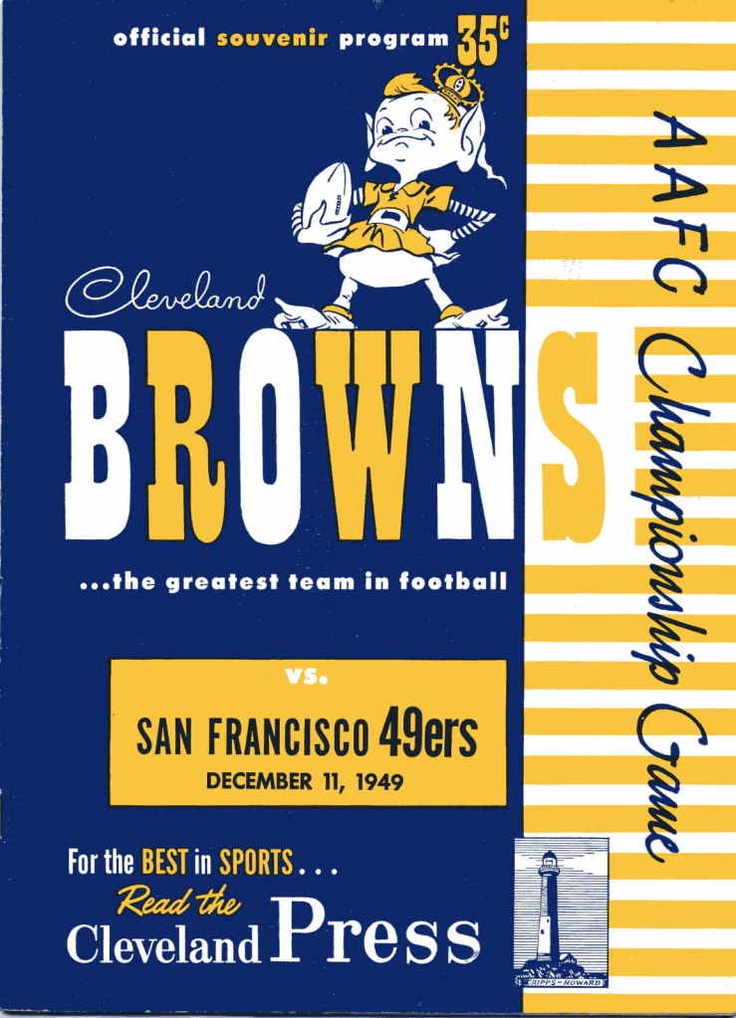
So bored were Browns fans with winning, barely 22,000 fans showed up to Municipal Stadium for the 1949 championship game (today’s Browns fans should live so long!). The small crowd had been anticipated, prompting 49ers owner Tony Morabito to suggest the game be moved to San Francisco. The Browns, however, declined.

The end of the AAFC

On November 30, 1949, AAFC commissioner Kessing defiantly told United Press (UP) that the league would have eight teams in place for the 1950 season.20AAC To Have Eight Teams, AP via the Daytona Beach Morning Journal, Nov. 30, 1945 The eighth team most likely was a proposed expansion team in Houston. Oilman Glenn McCarthy was expected to be granted a franchise at the AAFC meetings scheduled for the following month. Kessing added that the AAFC was not interested in a merger with the NFL.
A week later, unbeknownst to Kessing, NFL commissioner Bert Bell met with Browns minority partner Dan Sherby and the football Yankees team attorney, Arthur Friedlund. The three hammered out a merger, of sorts, which Bell announced on December 9, two days before the AAFC Championship game. As part of the deal, Bills owner James Breuil acquired a minority stake in the Browns. The Chicago Hornets disbanded. The Los Angeles Dons merged with the NFL Rams, while the New York Yankees merged with the NFL’s New York Bulldogs. The Browns, San Francisco 49ers, and, oddly, the Baltimore Colts would join the NFL.
Baltimore’s inclusion was a headscratcher. The Colts finished 1-11 in 1949 and were on shaky financial ground. Their final home game against the Bills drew just over 16,000 fans. Meanwhile, Buffalo’s average attendance in 1949 was 26,000, some 3,000 fans a game better than the NFL average. The decision to leave Buffalo out was purely financial. Owner James Breuil was more than happy to gain a stake in the very successful Browns and fold his franchise. He claimed the Bills, despite strong fan support, had cost him over $700,000 in the AAFC’s four-year existence.

The very last AAFC game

While the AAFC had technically gone out of business two days before its final championship game, it still had one last game to play. On December 17, 1949, the AAFC All-Stars met the league champion Browns in a charity game called the Shamrock Bowl in Houston’s Rice stadium. The game was organized by Glenn McCarthy as part of his attempt to bring pro football to the city. The Browns lost 12-7 in front of 10,000 rain-soaked onlookers. The final gun of that game marked the end of the All-America Football Conference.


All-America Football Conference Franchise List

FRANCHISEYEARS ACTIVEAAFC CHAMPIONSHIPSNOTES
Baltimore Colts1947-1949NONEJoined NFL in 1950. Folded after one year.
Brooklyn Dodgers
1946-1948NONEMerged with New York Yankees 1949
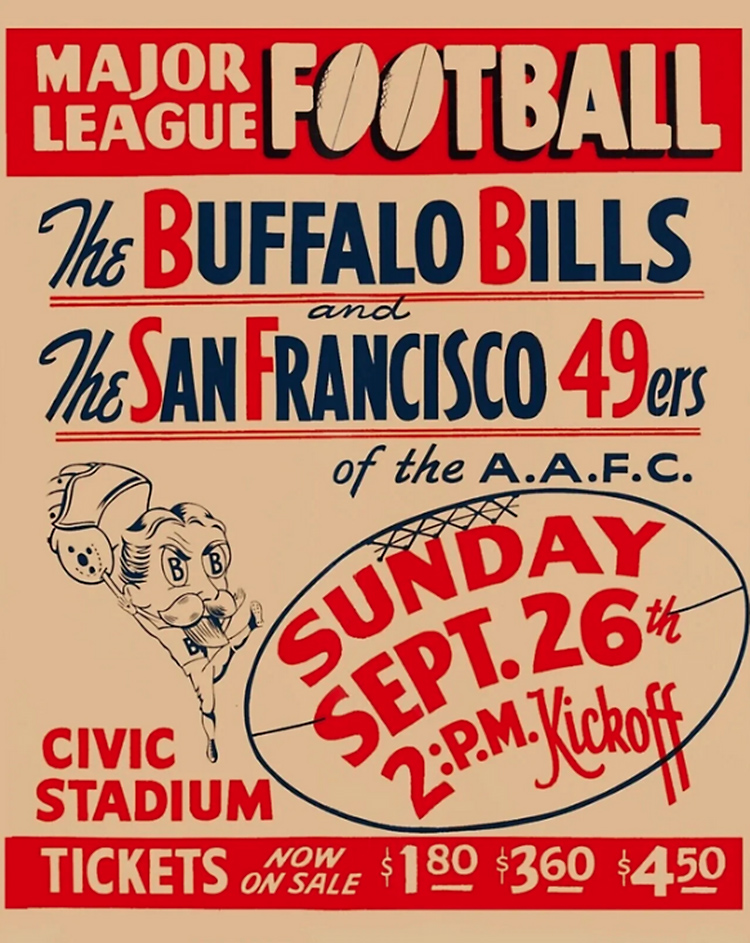
Buffalo Bisons-Buffalo Bills1946-1949NONEBisons 1946, Bills 1947-1949
Chicago Hornets1946-1949NONEBegan as Chicago Rockets in 1946. Sold and rebranded as Hornets for 1949.
Chicago Rockets1946-1949NONESold and rebranded as Hornets for 1949.
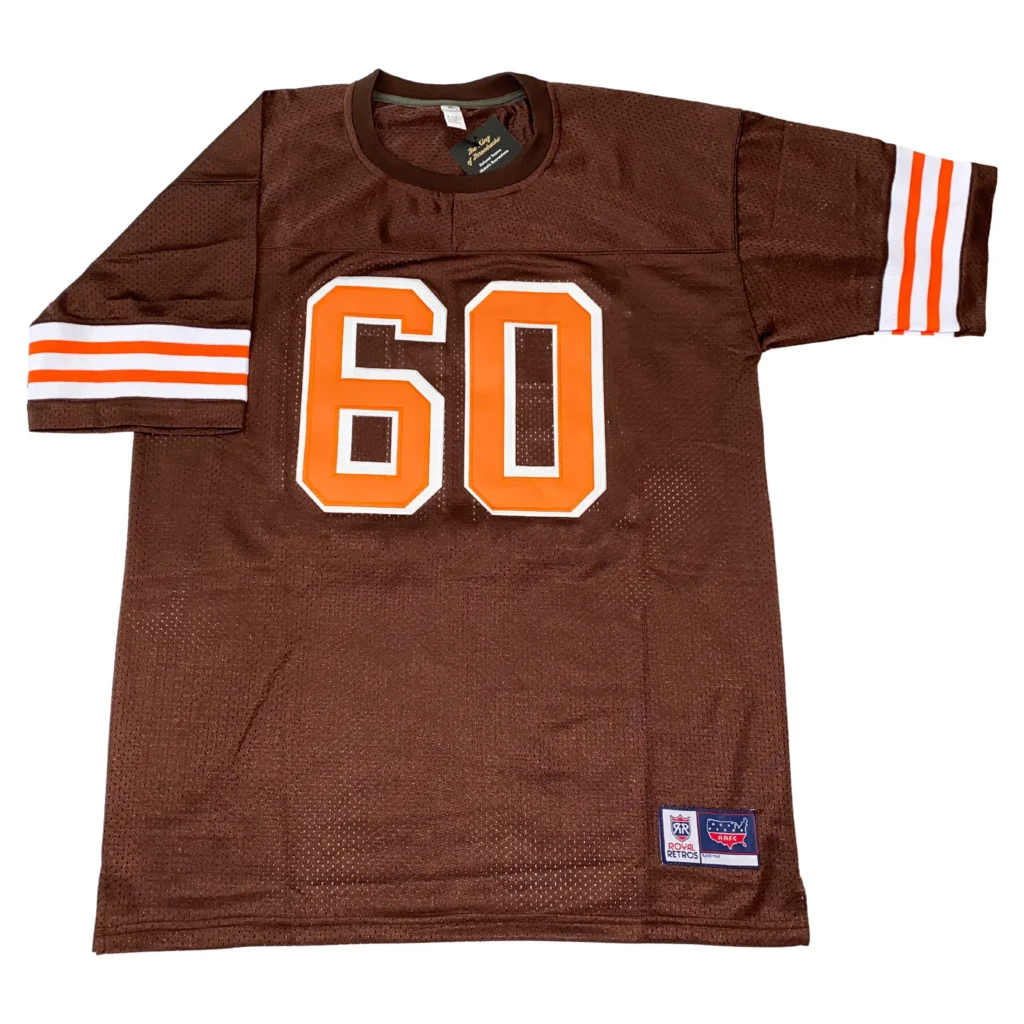
Cleveland Browns1946-19491946, 1947, 1948, 1949Joined NFL 1950
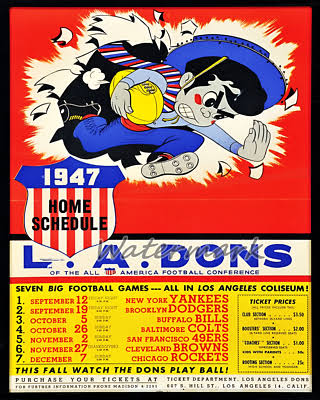
Los Angeles Dons1946-1949NONEMerged with Rams after AAFC/NFL merger
Miami Seahawks1946NONEBecame Baltimore Colts
New York Yankees1946-1949NONEFormer NFL Brooklyn Dodgers
San Francisco 49ers1946-1949NONEJoined NFL 1950


##

Comments

Share