
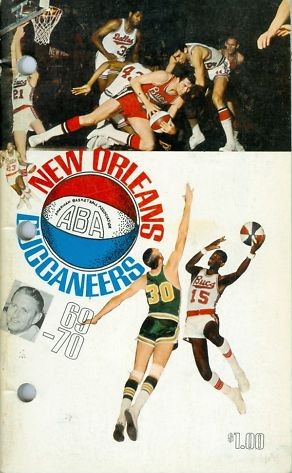
American Basketball Association (1967-1970)
Tombstone
Born: February 2, 1967 (ABA founding franchise)1Expect Mikan To Head ABA, UPI via The News-Dispatch, Feb. 2, 1967
Relocated: August 31, 1970 (Memphis Pros)2Buccaneers Memphis bound, AP via The Southeast Missourian, Sep. 1
First Game: October 19, 1967 (W 120-112 vs. Houston Mavericks)
Last Game: April 15, 1970 (W 145-127 vs. Dallas Chaparrals )
ABA Championships: None
Arenas
Loyola Field House (1967-1969)
Opened: December 5, 19543Loyola University Drops Segregation, AP via The Lewiston Daily Sun, Nov. 26, 1954
Demolished: 1986
Tulane Gym (1969-1970)
Dedicated: October 27, 19334Tulane Will Dedicate $190,000 Gym Tonight, AP via The Tuscaloosa News, Oct. 27, 1933
Municipal Auditorium (1969-1970)
Opened: January 30, 19305Preservation Resource Center of New Orleans
Marketing
Team Colors: 6TruColor
Red, navy, white
Ownership
Morton Downey Jr., L. Torrey Comila, Ronnie Kole, James A. Ware, Lionel J. Cunningham, Charles G. Smither, et al.
Background
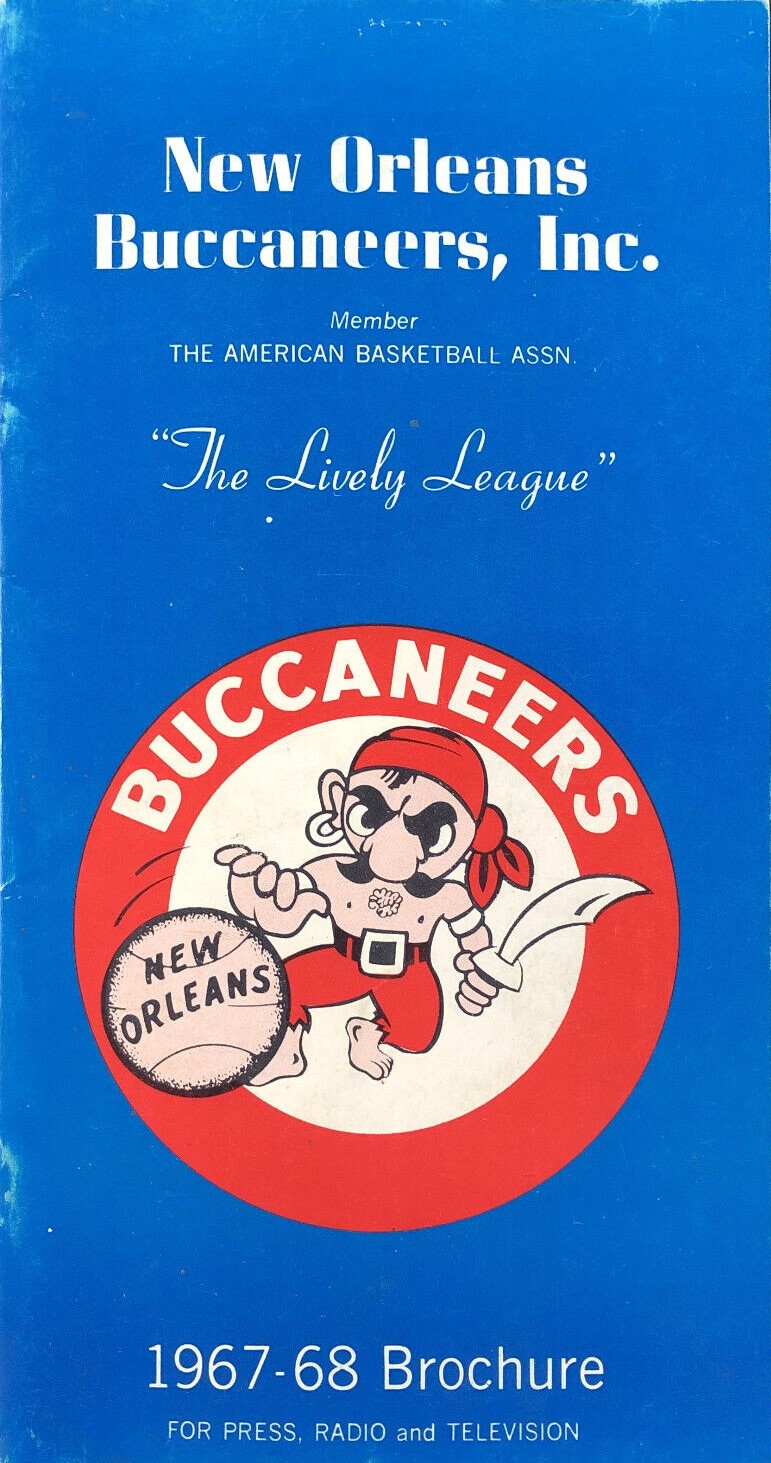
The New Orleans Buccaneers were charter members of the American Basketball Association (ABA) in 1967. The team played in the Big Easy for three years before being sold and relocated to Tennessee, where they became the Memphis Pros.
In the Amazon Prime documentary series Soul Power: The Legend of the American Basketball Association, Pat Boone, a partner in the Oakland Oaks franchise, stated: “I’m the only entertainer who was ever involved, that I know of, in the ABA.” The late Morton Downey Jr. (who appeared in the 1997 HBO doc Long Shots: The Life and Times of the ABA) would surely have disagreed. Widely remembered for his bombastic, eponymously titled TV talk show of the late 1980s, Downey had been kicking around the edges of show business since the early 1950s.
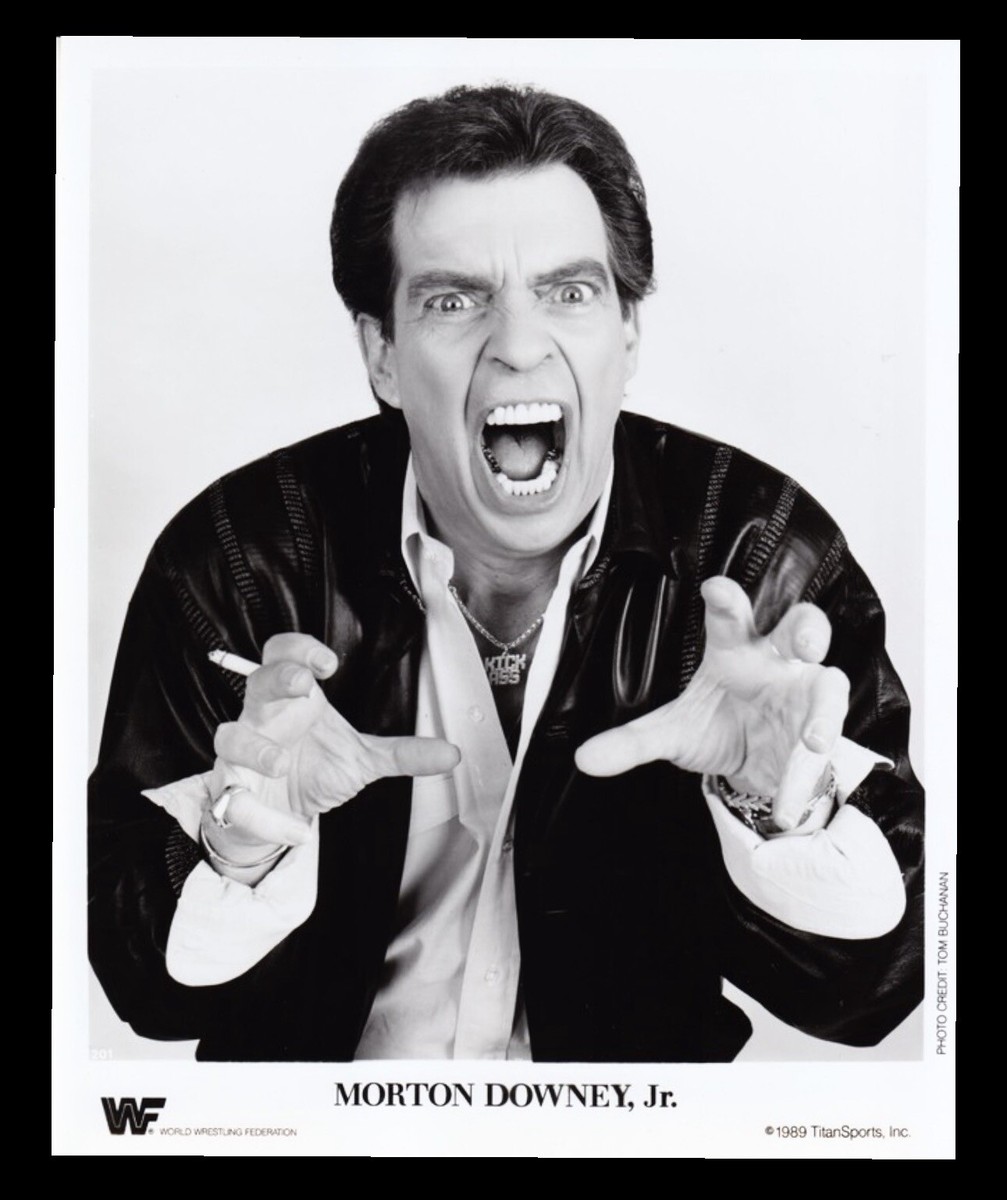
He started as a radio DJ/program director and sometime singer/songwriter, who found himself in New Orleans in the mid-’60s working not in broadcasting, but as the general manager of the Canteen Corporation of Louisiana. When the ABA was lining up owners for its inaugural season, Downey became the frontman for a syndicate that acquired the New Orleans franchise. He took an active role in not only fronting the owneship group but also being somewhat of a league spokesman in the ABA’s first few months of existence.7Louisville Gets Franchise In New Loop, UPI via The Pittsburgh Press, Mar. 6, 1967
A day after the league was officially announced, Downey held a press conference in which he detailed the plans of the New Orleans franchise. The team would be called the New Orleans Buccaneers, play its home games at Loyola University’s field house, and that the organization was seeking basketball legend Bob Pettit as coach.8New Orleans Wants Pettit As Cage Coach, AP via The St. Joseph News, Feb. 4, 1967
Pettit, a Louisiana native who had retired from the NBA two years earlier, ultimately declined the offer. However, the Bucs did just fine without him, as former Mississippi State head coach Babe McCarthy took the job instead.
 Among the first players acquired by the team were former University of North Carolina standout Larry Brown and his buddy Doug Moe. The latter had been playing in Italy when Downey contacted them.
In Long Shots, Brown recounts his and Moe’s first meeting with Downey. The duo was unable to find the offices of the New Orleans Buccaneers on Barone Street, but did spot Downey’s name listed with the Canteen Corporation of Louisiana in the lobby of one of the buildings. When they reached his office, the future talk show host casually flipped over the sign on his desk, exposing the words “Sean M. Downey, President and GM, New Orleans Buccaneers.”
Checks were cut, and the two players immediately headed to the bank. “They were sure the checks were going to bounce,” Downey recalled in Long Shots. “They came back the next day, and they were dumbfounded. The checks cleared.”
“Which was mindboggling,” Brown added.
“They had money to be in New Orleans and have some fun,” Downey continued. “And they started to believe we were going to end up playing ball.”
And play ball they did. Brown and Moe were joined by talented Grambling product Jimmy Jones. All three were chosen for the All-Star team in the ABA’s first season and led the Bucs to the Western Division crown with the third-best record in the league at 48-30. Unfortunately, there were few fans to share in the excitement as the team averaged just over 2,000 fans a game, though larger crowds started showing up as the season wore on. The final regular-season home game, for example, drew over 4,500.
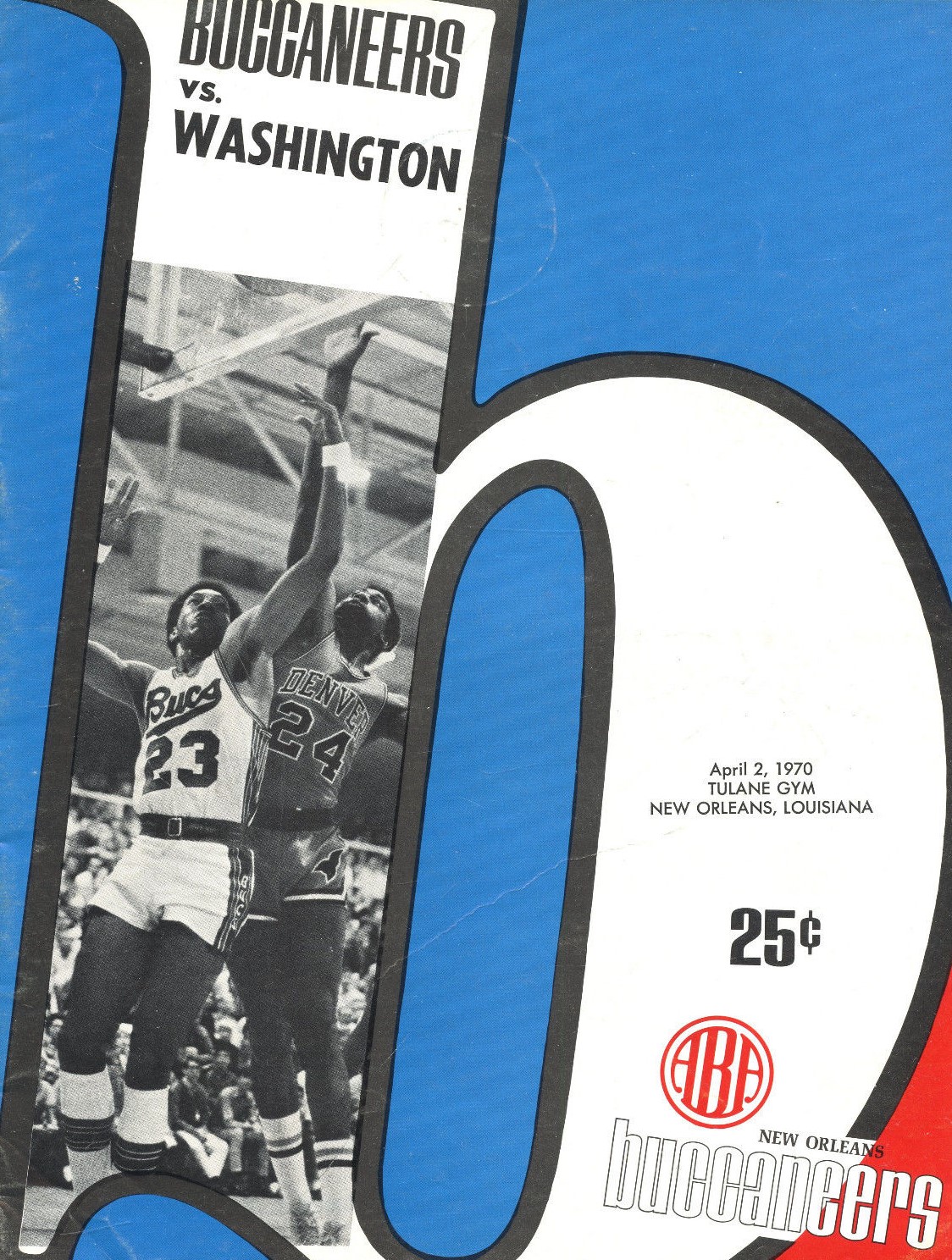 In the playoffs, they knocked off the Denver Rockets in the division semifinals, 3 games to 2. They then ousted the Dallas Chaparrals in the division finals, 4 games to 1. They pushed the ABA’s first championship series to a deciding Game 7 but lost the title to the Pittsburgh Pipers.
The following year, the Bucs traded Brown and Moe to the Oakland Oaks for Steve Jones and Ron Franz. The Oaks, who were now able to use the services of superstar and former San Francisco Warrior Rick Barry, instantly became a juggernaut. Barry had been forced to sit out the previous year due to an injunction filed by his former team. With Brown and Moe, Barry and the Oaks went from 22-56 cellar-dwellers in 1967-68 to a league-best 60-18.
The Bucs managed to finish in second place in the West, 14 games behind the Oaks. While New Orleans managed to edge Dallas in the division semifinals, 4 games to 3, the eventual champion Oaks eliminated them in the division finals.
In their final season in the Crescent City, the Bucs went 42-42, but that mark found them at the bottom of the ABA’s Western Division and out of the playoffs. In early August 1970, a group of investors from New York made an offer to buy the club and move it to Memphis.9ABA Buccaneers Ready To Move? AP via The Evening Independent, Aug. 7, 1970 When that deal fell through, the team was sold to P.L. Blake of Greenwood, MS, who went ahead with the relocation to Tennessee, where the team became the Memphis Pros.10Memphis Gets N.O. ABA Club, AP via The Herald-Journal, Sep. 1, 1970
Pro basketball returned to New Orleans on March 7, 1974, when the NBA awarded the city an expansion franchise.11NBA franchise in New Orleans, UPI via The Daily Sentinel, Mar. 8, 1974 That fall, the New Orleans Jazz debuted but stayed only five seasons before moving to Salt Lake City and becoming the Utah Jazz.12Jazz given go-ahead for move to Utah, AP via The Day, Jun. 9, 1979 That left the city, once again, without pro basketball. This time, the drought lasted more than two decades before the Charlotte Hornets announced their intention to relocate to Louisiana.13Hornets, New Orleans will be ‘a perfect fit,’ AP via The Vindicator, Jan. 17, 2002The move was granted by the league in May, 2002.14Hornets’ move to New Orleans approved, AP via The Harlan Daily Enterprise, May 11, 2002
At first, the franchise hoped to become the new Jazz and asked Utah to relinquish the name, but that team’s management declined. They, instead, became the New Orleans Hornets.15Jazz name will remain in Utah, The Desert News, Jun. 1, 2002 In 2012, though, Tom Benson, owner of the NFL Saints, bought the team and almost immediately expressed a desire to change the team’s name to something that better reflected the city’s culture and history. Benson settled on the Pelicans. This then allowed the Charlotte Bobcats, who were established in 2004, to reclaim the Hornets name.
Links
###
2 Responses
The guy they got from the Oakland Oaks was Ron Franz, not Rod Franz. Ron went to Ward HS in KC, Kansas and I played against him in high school–he graduated from HS in 1963.
Oh, nice catch! Corrected.