
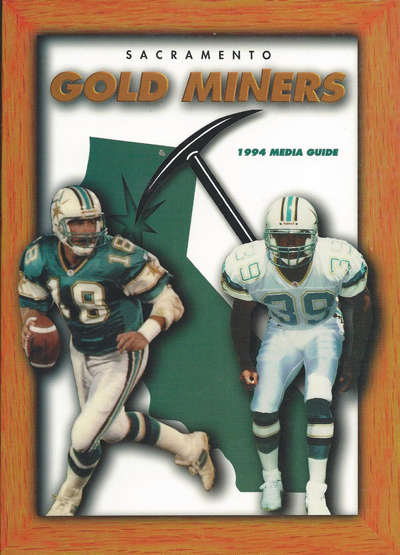
Canadian Football League (1993-1994)
Tombstone
Born: February 26, 1993 – CFL expansion franchise11994 Canadian Football League Facts Figures & Records
Moved: February 1995 (San Antonio Texans)
First Game: July 7, 1993 (L 32-23 @ Ottawa Rough Riders)
Last Game: November 5, 1994 (W 18-0 vs. Baltimore Football Club)
Grey Cup Championships: None
Stadium
Hornet Stadium (24,000)21994 Canadian Football League Facts Figures & Records
Branding
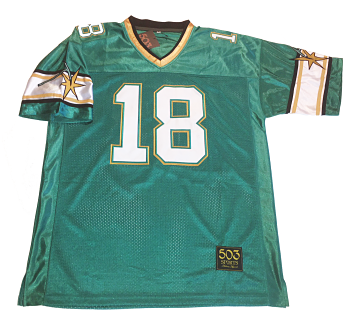
Team Colors: Aqua & Old Gold31994 Canadian Football League Facts Figures & Records
Ownership
Owner: Fred Anderson
Background
The Sacramento Gold Miners were the first U.S.-based franchise admitted into the Canadian Football League during the CFL’s short-lived American expansion adventure from 1993 to 1995.
The Gold Miners weren’t a brand new operation though. Owner Fred Anderson’s team previously played in the NFL-sponsored World League of American Football (WLAF) as the Sacramento Surge in 1991 and 1992. The Surge won the 1992 World Bowl as champions of that league. After NFL owners pulled the plug on the WLAF in September 1992, Anderson applied for entry to the CFL. The team retained its color scheme, Head Coach Kay Stephenson and a number of players from the WLAF era, but changed its name upon joining the CFL.
Tepid Support
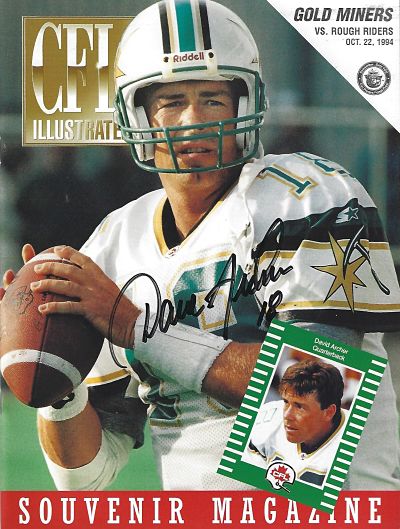
The Gold Miners finished last in their division with a 6-12 record in 1993. Quarterback David Archer, and NFL veteran, finished second in the league in passing yards (6,023) to Doug Flutie. Running back Mike Oliphant led the CFL in yards from scrimmage (1,572). In an ominous sign for the league’s American incursion, Sacramento’s 1993 average attendance of 16,979 fans per game was the lowest in the 9-team CFL.
After playing as the lone American team in 1993, Baltimore, Las Vegas and Shreveport, Louisiana joined the league for the 1994 season. While the Baltimore team was a hit on and off the field, Las Vegas was a disaster while Sacramento and Shreveport were among the weaker entries. Sacramento’s 1994 attendance of 14,226 was 11th in the league, stronger only than the epic misfire taking place in Las Vegas.
Move To Texas
After two money-losing years at Sacramento’s Hornet Stadium, Fred Anderson moved the team to the Alamodome in San Antonio, Texas for the 1995 CFL season. The Texans lasted for one season in San Antonio, but shut down in early 1996 after the rest of the CFL’s American teams disbanded. The CFL returned to being a Canada-only circuit in 1996 and has been ever since.
Sacramento Gold Miners Video
TSN coverage of the Gold Miners CFL debut at Lansdowne Park in Ottawa. July 7th, 1993
In Memoriam
Gold Miners owner Fred Anderson passed away on March 24, 1997 at age 72.
Links
##
One Response
Like its prior incarnation as the “Surge”, the Sacramento-based CFL Gold Miners were DOOMED from the start, due to lack of a suitable venue. Sacramento State’s Hornet Stadium was fine for what it was built for…a then Division-II (now FCS) level college football program. As even a second-tier or “AAA” football venue, it was patently undersized and inadequate, despite the growing Sacramento area, which had already shown its enthusiasm for the NBA’s Kings, recently moved to the River City for the 1985-1986 season and playing in the then-new ARCO (later “Sleep Train”) Arena, since demolished after the Kings moved to their downtown Golden One Center in 2015. The other football stadiums, Sac City’s Hughes Stadium, and UC Davis’ Toomey Field (replaced in 2007 by UC Davis Health Field, still too small in its current 10K seating capacity, but able to be readily expanded to about 30K seats if the program or a pro tenant justified it), were even worse than Hornet Field. Stagg Field in nearby Stockton had the capacity at nearly 30K, and could be expanded to about 40K if needed, but the UOP Tigers football program itself was foundering and would be discontinued in 1995. The aging, then fifty-year old stadium badly needed renovation, and without a viable football program, the University was unwilling to spend money on it. The Gold Miner’s nearest CFL opponent, the Las Vegas Posse, had been a disaster and embarrassment off and on the field in its lone season in 1994. It’s last home game was moved to Edmonton with the league paying for the travel expenses so the Posse could finish their season of futility. This left the nearest CFL team in Vancouver, BC, some 1300 miles away, but at least in the same time zone, and the nearest USA-based team in Shreveport, LA, some 1,800 miles distant. A final consideration of Fresno, CA was rejected as the Fresno State Bulldogs didn’t want to work out the scheduling conflicts and extra field wear that’d arise from having a pro tenant.
This left relocation as the only option left. The CFL, pleasantly surprised at the runaway success that was their Baltimore club, was willing to try one more season to see if US fan interest would be sufficient for their brand of football. There was a city that had a new indoor 65K stadium, built in anticipation of winning an entry for the 1993 award of two NFL expansion franchises. The timing couldn’t have been WORSE, as the recently resurgent Dallas Cowboys voted against the San Antonio entry, and the Houston Oilers, unhappy with the Astrodome and sagging attendance, were looking to relocate as their their lease was up. Once the Oilers departed for Tennessee, the NFL prioritized getting a replacement into the nation’s 4th-largest city and TV market. This left the Alamodome with no expected NFL tenant. There had been an unsuccessful World League franchise, the Riders, that played in San Antonio in 1991 and nearby San Marcos in 1992, both seasons to sparse crowds. With the WLAF being placed on hiatus after the 1992 season, the Riders would not get the expected TV money, they had no funds to put a down payment on a lease for the new ‘Dome which would open as of May 1993. Sadly, the Riders, having applied to and accepted by the CFL, had their loans called in, and had to fold. They would have been renamed the “Texans” had they continued. When Surge/Gold Miners owner Fred Anderson decided to relocate to San Antonio for the 1995 CFL season, the Rider’s creditors, having a storage unit full of unused “Texans”-branded equipment, like helmets and jerseys, were only too happy to accept Anderson’s offer to buy them and the team name. The football team did well on the field, going 12-6 and making the playoffs, but attendance was only fair. The same problem of Texans shunning any competitor to “Friday Night Lights” and Saturday College ball, which are all but RELIGION in Texas and the South, still was a problem that marketing couldn’t overcome. To make it worse, the other “Southern” USA CFL teams did even WORSE at the gate, and save for the Baltimore Stallions, the CFL had enough of it’s “American experiment”. The might have been willing to continue with the Stallions and the Texans, but when the Cleveland Browns announced their move to Baltimore for the 1996 season, that was the end of the Stallions as an American-based CFL team. Attempts to relocate to DC (RFK Stadium) and Houston (Astrodome) were rebuffed an interfered with by the NFL, despite the NFL tenants of both venues moving out after the 1996 season. This left Jim Speros with but the obvious choice to move the team to Montreal and become the third, and thus far, lasting incarnation of “les Alouettes”. The League simply wasn’t interested in scheduling and travelling to a lone USA-based team in Texas, and no Canadian city that was considered large enough to support a CFL team had a usable stadium. Anderson, having lost $6 million on his CFL venture, accepted the buyout of his CFL franchise and folded the team.