
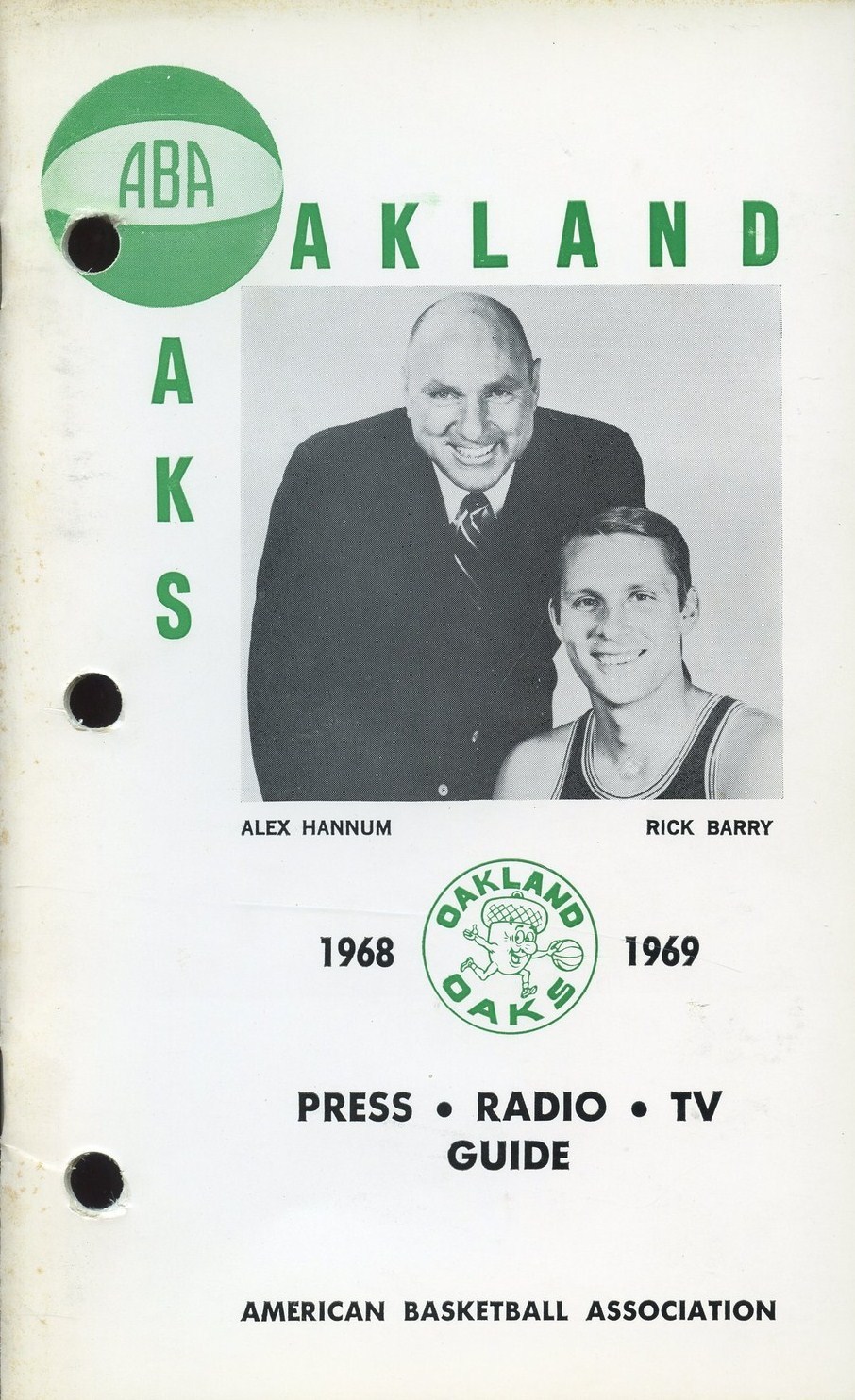
American Basketball Association (1967-1969)
Tombstone
Born: February 2, 1967 (ABA founding franchise)1Expect Mikan To Head ABA, UPI via The News-Dispatch, Feb. 2, 1967
Moved: August 20, 19692ABA Reports Sale Of Oakland Oaks To Earl Foreman, AP via The Victoria Advocate, Aug, 21,1969
First Game: October 13, 1967 (W 134-129 vs. Anaheim Amigos)
Last Game: April 16, 1969 (W 115-102 vs. Denver Rockets, Game 7, ABA Championship)
ABA Championships: 1969
Arena
Oakland Arena
Opened: November 9, 19663Seals christen new arena, 6-5, UPI via The Windsor Star, Nov.10, 1966
Marketing
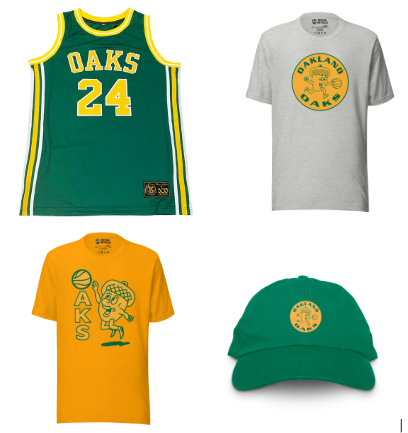
Team Colors: TruColor.netKelly green, gold, and white4TruColor.net
Ownership
Owners: S. Kenneth Davidson, Dennis Murphy, Pat Boone, Alex Hannum et al.
Background
The Oakland Oaks were charter members of the American Basketball Association (ABA) and were introduced, along with the rest of the new league, on February 2, 1967. The franchise’s initial investors were league co-founder Dennis Murphy, along with Los Angeles-based insurance executive S. Kenneth Davidson. The latter pulled in entertainer Pat Boone, an avid basketball fan.
“I was intrigued,” Boone told the Good Seats Still Available Podcast in 2017. “I wasn’t going to invest money in it. I knew it was very speculative.” Boone received ten percent of the club in exchange for being listed as the team’s president, a move designed to lend an air of credibility to the franchise, as well as the ABA.
Rick Barry signing
The Oaks quickly assembled an impressive roster that included future NBA coaches Doug Moe and Larry Brown. Their biggest get, though, was local hero Rick Barry, who inked a deal with the Oaks in June, just a few months after his contract with the San Francisco Warriors had ended.5Barry Defects To New Loop, AP via The Park City News, Jun. 21, 1967 The deal, however, ran into a roadblock.
 “The NBA and the Warriors wouldn’t let Rick Barry play for us,” Boone explained in his Good Seats appearance. “They got an injunction against him playing for us because he was signed to the reserve clause.” In other words, Barry either played for the Warriors or no one for the 1967-68 season.
“Our ABA lawyers, who were very expensive,” Boone continued, “and should have known what they were talking about, decided the reserve clause was a restraint of trade preventing a player like Rick from playing where he wanted to.” This strategy would be used by future rebel leagues, especially those involving the ABA’s founders.
Barry sits out the season
The case was heard in San Francisco. “Guess what? The local judge sided with the Warriors,” Boone laughed. The judge determined that the Warriors still held a one-year option on the star player. Barry then opted to simply sit out the season. He still became part of the Oaks organization, though, by providing color commentary for the team’s radio broadcasts.
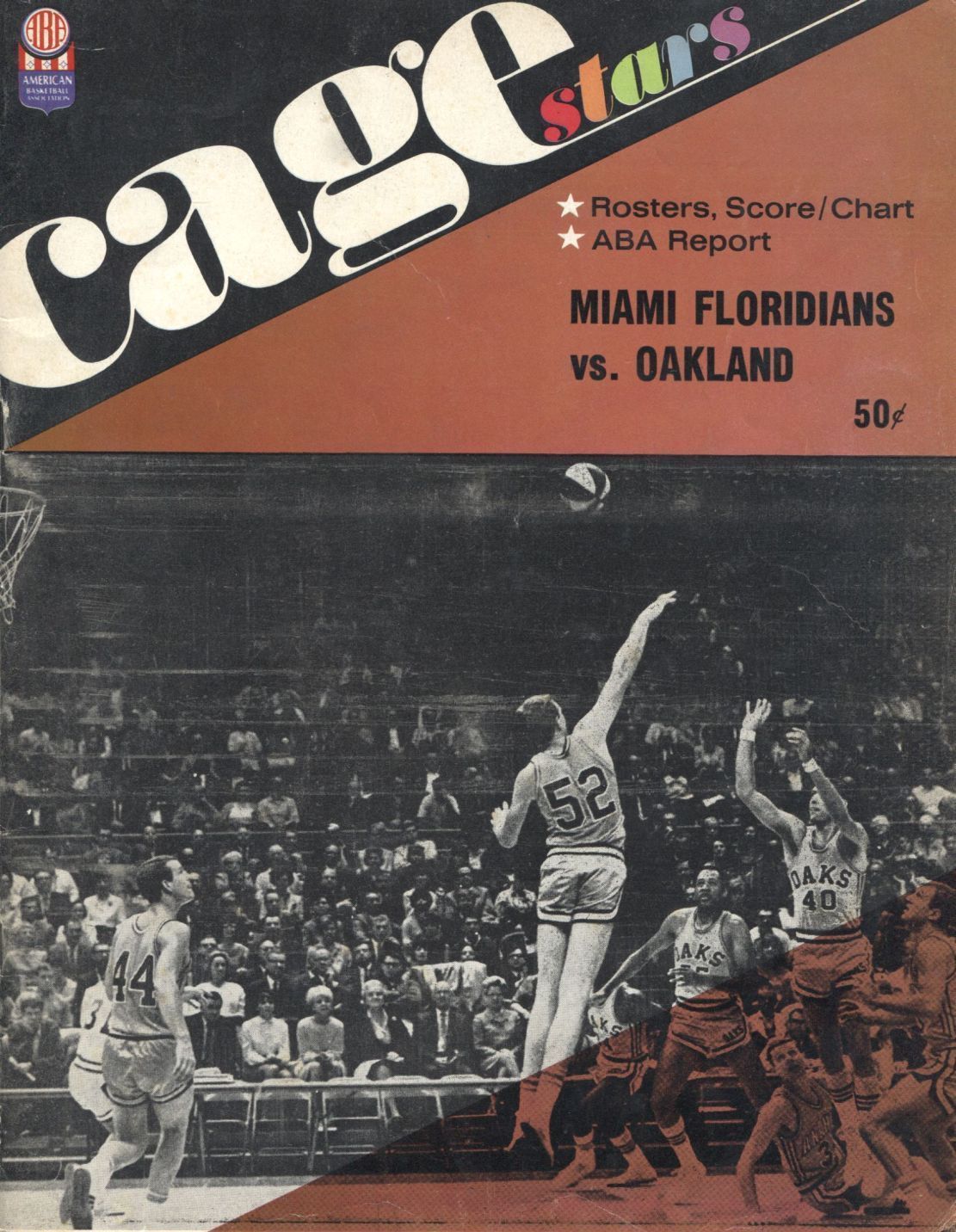
The Oaks played their first regular-season game on October 13, 1967, which was also opening night for the entire league. A crowd of 4,848 showed up at the Oakland Arena to watch the Oaks defeat their California rivals, the Anaheim Amigos, 134-129. Across the bay, the Warriors topped the expansion Seattle SuperSonics 144-116. Following a pre-game awards ceremony in that NBA contest, San Francisco fans shouted, “Where’s Barry?”6Oaks, Warriors Win Cage Openers, The Warsaw Times-Union, Oct. 14, 1967
Worst to first
Despite a winning start and a respectable roster even without Barry, the Oaks went on to finish dead last in the league with a record of 22-56. The following season, though, in 1968, Barry was able to play for the Oaks. The team also acquired future superstar Warren Jabali, who went on to win Rookie of the Year honors. Mel Daniels came over from the Minnesota Muskies and captured the MVP award. The Oaks went from the bottom of the standings to the best record in the league by 14 games.
While the regular season was a breeze, the postseason proved to be a bit more challenging for the Oaks. The Denver Rockets took them to seven games before succumbing. Things got a little easier in the division finals, where they swept the New Orleans Buccaneers, the team with ABA’s next-best record in the division finals, before dispatching the Indiana Pacers in five games to capture the title.
No money, mo’ problems
Unfortunately, the Oaks’ winning ways and a lineup that featured three of the league’s top stars couldn’t get fans to come to the Oakland Arena. The team’s final regular-season game, for example, against the L.A. Stars drew just 733 fans. Across the bay, the Warriors, playing .500 ball and just barely making the playoffs, continued to pull in the area’s basketball fans.
Just before the end of the season, Davidson tried to unload his 51% stake in the team on Houston-based stockbroker Lewis Bracker, who in turn planned to withdraw the team from the ABA, move it to Houston, and enter the NBA.7Broker’s NBA Vision Dulled By Legal Snarl, TP via The Toledo Blade, Apr. 10, 1969 Only one owner in the established league objected but that was enough to scuttle the sale. Houston, incidentally, had an ABA team, the Mavericks, but it left for Charlotte, NC, about a week before Davidson and Bracker attempted to consummate their deal.
Losing tons of money, Davidson nearly declared bankruptcy. That’s when Boone found out he might wind up on the hook for over a million dollars owed to the team’s bank. The singer had never agreed to take on any financial responsibility for the team, yet the bank insisted he owed them the money and was prepared to take swift legal action.
A way out
“Alex Spanos contacted me,” Boone said, “and asked, ‘How would you like to have a partner?’ I’ll take over the team and give you twenty percent.” Boone declined and almost immediately regretted the decision. Spanos would eventually buy the San Diego Chargers.
By mid-August, with just two months to go until the start of the ABA’s third season, things were looking desperate for the Oaks. Earl Foreman, who would later found the Major Indoor Soccer League, came to the rescue, bought the Oaks from Davidson, Boone, and coach Alex Hannum (who owned a 15% stake) for $2.6 million. He promptly moved them to Washington, D.C.8Oaks go to Washington, but will Barry, Hannum?, UPI via The Bulletin, Apr. 21, 1969 The team was renamed the Washington Caps.
Barry didn’t want to go to Washington and insisted that he had a verbal agreement with the Oaks’ previous ownership group that if the team moved, he wouldn’t have to. Foreman felt otherwise, telling the press that Barry’s contract, obligating him to play for the franchise no matter where it was located, was one of the assets he acquired when he purchased the team. The courts eventually agreed, and Barry, after sitting out nearly half the season, played for the Caps. At the end of the season, he offered to buy out his contract so he could return to the Warriors. The cash-strapped Foreman, however, arranged for Barry to be traded to the ABA’s New York Nets. A native of nearby Elizabeth, New Jersey, Barry agreed and went on to great success in the Big Apple.
The relocation helped establish a somewhat embarrassing trend in the ABA, as the league’s previous champions, the Pittsburgh Pipers, moved to Minnesota after winning the title a year earlier. In his book Breaking the Game Wide Open, league co-founder Gary Davidson wrote sarcastically of the shifts, “Naturally, it is very important to move your champion to a new city every season, it seems.”9Breaking the Game Wide Open, Gary Davidson with Bill Libby, 1974, p. 39
The Oaks were renamed the Washington Caps, and after one season in the nation’s capital, they moved across the Potomac River and down to the Hampton Roads area to become the Virginia Squires. Two years later, the San Francisco Warriors rebranded as the Golden State Warriors and moved into the Oaks’ old home, the Oakland Arena.
Pat Boone received offers to join the ownership group of the NBA’s Phoenix Suns and, later, the Dallas Mavericks, but he declined. The experience with the Oaks left him skittish about being a sports franchise owner, even in a limited capacity. The team he helped found gained a small but loyal following in Virginia; however, the team folded a month before the NBA/ABA merger in 1976.
Pat Boone interview, Good Seats Still Available podcast
One of our favorite episodes ever of Good Seats Still Available is this one with Pat Boone recounting his involvement as a part-owner of the Oakland Oaks.
In Memoriam
Coach Bruce Hale passed away on December 30, 1980 at age 6010Cage Coach Hale Dies, AP via The Ludington Daily News, Jan. 2, 1981
Coach Alex Hannum passed away on January 18, 2002 at age 11Fourth Quarter, via The Daily News, Jan. 20, 2002[/fn]
Links
###