
American Football League (1960-1963)
Tombstone
Born: August 1, 1959 (AFL founding franchise)1New Pro Circuit Named American Football Loop, AP via The Lawrence Daily Journal-World, Aug. 1, 1959
Relocated: May 22, 1963 (Kansas City Chiefs )2Texans Headed for Kansas City, AP via The Victoria Advocate, May 23, 1963
First Game: September 10, 1960 (L 21-20 @ Los Angeles Chargers)
Last Game: December 23, 1962 (W 21-20 vs. Houston Oilers, AFL Championship Game)
AFL Championships: 1962
Stadium
Cotton Bowl
Dedicated: October 25, 19303Southern Methodist Stadium Dedicated, INS via The Telegraph-Herald and Times-Herald, Oct. 26, 1930
Marketing
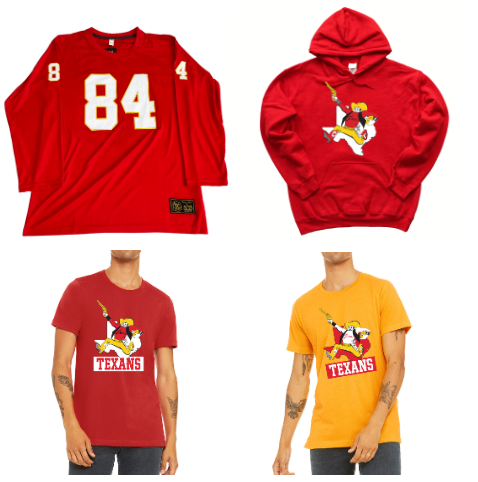
Team Colors: Red, Gold, and White4TruColors.net
Ownership
Owners: Lamar Hunt
Background
In the late 1950s, Lamar Hunt and several other wealthy football enthusiasts tried in vain to get the National Football League (NFL) to expand. When their attempts were thwarted, Hunt and his peers figured, “If you can’t join ’em, start a new football league,” and that’s exactly what they did. On August 1, 1959, Dallas native Hunt announced the formation of the American Football League (AFL) with plans to place a team in his hometown.5New Pro Circuit Named American Football Loop, AP via The Lawrence Journal-World, Lawrence, KS, Aug. 1, 1959
It didn’t take long for the NFL to swing into action. “Papa Bear” George Halas, Chicago Bears owner and head of the NFL’s expansion committee reached out to another Dallas oilman, Clint Murchison Jr. Like Hunt, Murchison had approached the NFL about expansion and had also been rebuffed. The established league, though, wasn’t as dismissive about Murchison, who they viewed as an established businessman, whereas the 26-year-old Hunt was a punk.
On August 29, 1959, the Bears were scheduled to play an exhibition game against the Pittsburgh Steelers in Houston, another city the NFL was suddenly very interested in. Murchison knew he had Halas and the NFL over a barrel and convinced Papa Bear to tell reporters that the league would expand for 1961 and that Dallas would get a franchise.
Lamar Hunt was trimming the hedges in his front yard when a reporter called for his reaction. Needless to say, the young oilman was stunned, later telling the press he thought it was a ridiculous idea.6NFL Plans Expansion to 14 Teams. Dallas, Houston Being Considered, AP via The Gadsen Times, Oct. 24, 1959His AFL cohort Bud Adams of Houston had more of a “Bring it on” attitude and told the press as much.
The idea of two pro teams in Dallas was indeed interesting, made even more so by the fact that the city had fielded an NFL team just a few years earlier in 1952. That squad, the Dallas Texans, was a disaster. So much so that the team’s owners gave the franchise back to the NFL after Week 7 of the regular season, forcing the league to run it for the club’s last five games.
Oddly, Hunt chose to call his team the Dallas Texans. He made the announcement in November 1959 and was the first to admit the name lacked originality, yet somehow it just fit. He also felt the public already associated it with pro football. At that time, Murchison’s group was operating as the Dallas Rangers as the NFL worked feverishly to vanquish the AFL on several fronts.
The established league’s first attempt at thwarting the upstart circuit was to offer Hunt and Adams the Dallas and Houston franchises in the NFL. When Murchison was chosen as the owner of the Dallas franchise, overtures were made to Hunt to join with a 45% stake. Hunt told Halas and the NFL, in so many words, that that horse had already left the barn.
On the eve of the AFL draft in Minneapolis-St. Paul, though, the NFL struck a major blow to Hunt and his colleagues. Halas managed to woo the owners of the new league’s Minnesota franchise over to the NFL. However, that made Hunt and the rest of the so-called “Foolish Club” even more determined to get their league off the ground.
Unable to derail the AFL, Halas and the NFL made it official on January 28, 1960, when the established league announced Dallas would be fielding a team for the 1960 season.7Dallas Texans to Give NFL Run for Its Money, AP via The Victoria Advocate, Jan. 29, 1960 The franchise was awarded after the NFL draft and had just eight months to put a team together. On March 19, the franchise switched nicknames from Rangers to Cowboys.8Dallas Switches to Cowboy Tag, UPI via The Pittsburgh Press, Mar. 20, 1960 As for colors, Hunt opted not to use the old Texans’ colors, instead going with red, gold, and white. That left the Cowboys with royal blue (the same as the old Texans) and white.
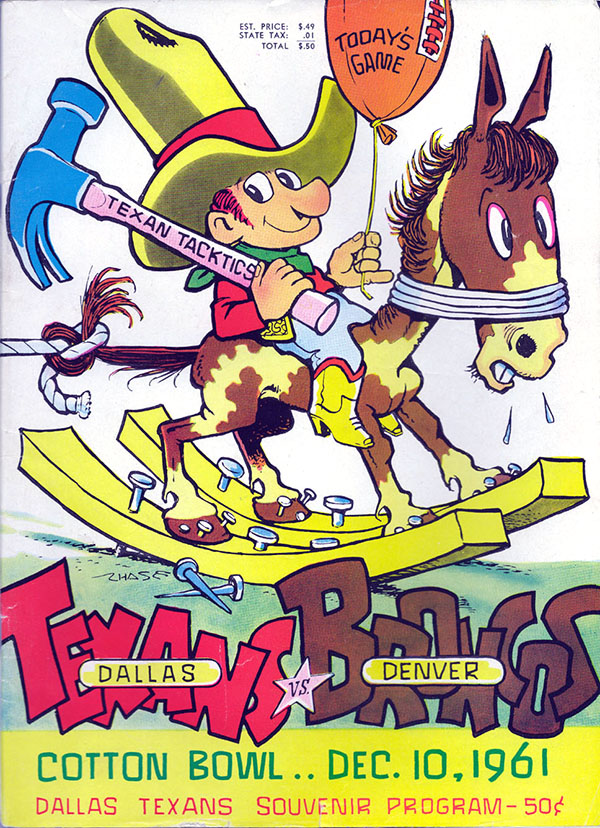
There was no turning back. Dallas, a city that lost a pro football franchise in a few short weeks in 1952, was going to have two major league teams playing in the Cotton Bowl in 1960. Through the hot Lone Star State summer, the Cowboys and Texans continued to prepare for their respective inaugural games.
The Texans sought New York Giants assistant Tom Landry as their head coach, but he opted to join the Cowboys, who also picked up a kid named Don Meredith to be their quarterback (eventually). Hunt, though, got Hank Stram to be his head coach and then proceeded to make some marquee signings, including Abner Haynes (drafted by the Steelers) and Johnny Robinson (drafted by the Lions). Hunt went as far as to visit Haynes at the young running back’s home and promised to top any offer the Steelers made. Haynes, who had a desire to play for the fans in his hometown and knowing the Hunt family had deep pockets, signed with the Texans.
On September 10, 1960, the Texans opened on the road against the Los Angeles Chargers and lost a squeaker 21 to 20. After topping the Raiders 34 to 16 in Oakland the following week, the Texans made their home debut on September 25 against the Chargers. Over 40,000 fans turned out to see the city’s AFL team make its debut, and they were rewarded with a 17 to 0 win. Just over 30,000 turned out the day before to watch the Cowboys drop their home opener 35 to 28 to the Abner Haynes-less Steelers.
The Dallas Texans were much more successful on the field than the Cowboys in that first season, but attendance numbers were largely even, as the winless Cowboys were able to bring marquee opponents to town, including the Browns, Eagles, Colts, and 49ers. Neither team made it to their respective league’s championship game. The Cowboys finished 0-11-1, while the Texans managed to notch a record of 8-6.
Texans vs. Cowboys Attendance:
YEAR TEXANS ATD AFL AVG TEXANS RECORD COWBOYS ATD NFL AVG COWBOYS RECORD 1960 24,500 16,583 8-6-0 21,417 40,106 0-11-1 1961 17,571 17,904 6-8-0 24,571 40,675 4-9-1 1962 22,201 20,487 11-3-0 21,778 40,851 5-8-1 1963* 21,510 21,584 5-7-2 26,961 42,486 4-10-0
*Dallas Texans became Kansas City Chiefs in 1963
In 1961, the Dallas Texans boasted the AFL’s best defense and had the distinction of being the only team in the wild new league to rush more times than it passed. In the last three games of the 1960 season, they allowed just one touchdown. However, they finished 6-8 in their second campaign.
To lure fans, the Texans offered discounted tickets at travel agencies, department stores, and other small businesses. They offered free tickets at sponsoring gas stations. To gain favor with high school football-mad Dallas residents, the Dallas Texans offered free admission to fans who could produce a ticket stub from a local high school game.
To improve the Dallas Texans for the 1962 season, Stram decided to bring in Len Dawson, whom he had coached at Purdue. Dawson, drafted originally by the Steelers, was on the Cleveland Browns’ roster and was not happy on the North Coast. He came to Dallas as the fourth QB on the depth chart. By the end of the preseason, he was the starter. With Haynes and Robinson in the backfield, and supported by a still stingy defense, the Dallas Texans made it to the AFL Championship against their arch-rivals the Houston Oilers.
The game was the longest pro football game in history up to that time, taking two overtime periods to decide. After 77 minutes and 54 seconds of play, kicker Tommy Brooker booted a 25-yard field goal to give the Dallas Texans a 20-17 win.
The championship, though, wasn’t enough to keep the Cowboys at bay. As the NFL team continued to improve, it became apparent that Big D just wasn’t big enough for the both of them. Hunt started looking for a new home for the Texans. As early as August of 1962, four months before the Dallas Texans won the title, rumors were swirling that the team was headed to New Orleans. Atlanta was also mentioned as a possible new home for the team.
It was Kansas City, however, that was the most proactive, as that city’s mayor, H. Roe Bartle, lobbied hard for the Dallas Texans to relocate to his town. In February of 1963, Hunt committed to K.C. provided the city could sell 25,000 season tickets. While that campaign fell short, Hunt was impressed with the town’s enthusiasm and decided to move the Dallas Texansto Missouri. The announcement came on May 22, 1963.
For a fleeting moment, Hunt considered keeping the Dallas Texans nickname, but his advisors talked him out of it. The name Chiefs was quickly chosen, and though the club embraced a Native American motif, the moniker was inspired primarily by Mayor Bartle, whose nickname was the “Chief.”
In Kansas City, the team continued its underachieving ways. They turned things around just in time to qualify for the first AFL-NFL World Championship Game, as they won the West Division title with a record of 11-2-1.
A few months earlier, on April 6, 1966, Hunt met with Cowboys GM Tex Schramm in the parking lot of Dallas’s Love Field. There, the two men sat in Schramm’s car. The Cowboys GM said to Hunt, “I think it’s time to talk about a merger.” Hunt said the AFL was interested.9The Ten-Gallon War: The NFL’s Cowboys, The AFL’s Dallas Texans and the Feud for Dallas’s Football Future, p. 248, John Eisenberger, 2012, Houghton Mifflin Harcourt Publishing Company, New York, NY, ISBN 978-0-547-43550-3
In 1949, the NFL, after four years, had managed to get its last rival, the All-American Football Conference (AAFC), to sue for peace. In that case, the NFL took in three of the AAFC’s surviving seven teams while the rest were disbanded. This time, the NFL was willing to take all of its rival’s teams, though the New York Jets and Oakland Raiders would have to move. NFL commissioner Pete Rozelle would head up the combined league. Lamar pushed back on the former, and a few other minor points, but on June 8, 1966, the deal was done.10AFL, NFL Merge into Gigantic 26-team League, AP via The Owosoo Argus Press, June 9, 1966 The two leagues would be one loop starting in 1970. In the meantime, the respective champions from each league would meet in a title game starting with the 1966 season.
A few months later, the Chiefs defeated the Buffalo Bills in the AFL Championship Game, sending them to what would be the first Super Bowl, then known as the aforementioned AFL-NFL World Championship Game. The Green Bay Packers, champions of the established league, vanquished the upstarts 35 to 10. The following season, the Packers downed the Oakland Raiders in a similar fashion, sending a clear message about who was the better league to the cocky AFL.
In 1969, the AFL’s New York Jets turned the fortunes of the AFL around by famously defeating the heavily favored Baltimore Colts 16-7. The following season, Hunt’s Chiefs evened things up in a storybook ending to the league he founded 10 years earlier, as his Kansas City Chiefs beat the Minnesota Vikings 23 to 7. It was the perfect way to close the AFL’s story.
Though he’d been a thorn in the side of Rozelle, Halas, and the rest of the NFL, Lamar Hunt went on to become one of the most respected owners in the combined league. He was also highly regarded in the world of professional sports in general. He developed, along with his heirs, the Chiefs into one of the most successful franchises in the NFL, both on the field and at the gate. He is also responsible for the success and popularity of outdoor soccer in the U.S., but that’s another story.
Our friends at the Good Seats Still Available podcast spoke King David Haynes, son of Texans legend Abner Haynes, about his father’s football career and work in the Civil Rights movement:
###
2 Responses
My name is George McGinnity I was the waterboy for Dallas when they came to Boston i worked the them for three seasons
i meet and liked Jim Barton,jJack Spikes and Abner Hanes we had some great times together
I alos meet and liked mr Stram and Mr Hunt what a fantastin man
if there are any celabrations of rhe old team i would love to come It been a long time but they would remember me george Maginnity 29 Mayflower road Arlington MA 617 335 9740 [email protected] i have a lot of great stories
That’s so cool, George! So, we’ve got to ask, what was the vibe really like in Big D with the Cowboys and Texans both competing for the hearts and minds of Dallas fans?