Born: January 29, 19521Dallas NFL Deal is Complete; New Team to Be Called Texans, UP via the Free Lance-Star, Fredericksburg, VA, Jan. 30, 1952
Franchise revoked: November 14, 19522Pro Grid Loop Rejects Offer, United Press via The Spokane Daily Chronicle, Nov. 15, 1952 New franchise awarded (using Texans’ assets/roster): January 7, 1953 (Baltimore Colts)3Bell Supports Industrialist as Club Owner, UPI, The Pittsburgh Press, Jan. 7, 1953
First Game: September 28, 1952 (L 24-6 vs. New York Giants) Last Game: December 13, 1952 (L 41-6 @ Detroit Lions)
Team Colors: Royal Blue, Silver, and White5TruColors.net
Ownership
Owners: Giles and Connell Miller
Background
On September 28, 1952, professional football arrived in North Texas as the new Dallas Texans of the National Football League (NFL) hosted the New York Giants in the Cotton Bowl. The team, however, barely lasted the season and holds the distinction of being the last NFL franchise to fail.
The team’s roots went back to 1943, when Ted Collins, manager of singer Kate Smith, among others, was awarded an NFL franchise for Boston.6Boston Awarded Grid Franchise for 1944, AP via The Gazette and Bulletin, Jun. 21, 1943 The Boston Yanks, as he dubbed them in April 1944, debuted the following September before nearly 20,000 fans in Fenway Park.
United we stand
Like any first-year team, the Yanks struggled. Indeed, Collins considered waiting until World War II was over before fielding a team, as the pool of players had been diminished by the conflict. However, he had already participated in the draft back in April, so he was committed to moving forward. The team finished 2-8, good for fourth place in its inaugural season. The following year, with the war still on, the Yanks merged with the Brooklyn Tigers, who notched a 0-10 record in 1944. The combined club split home games between Boston and Brooklyn.
The Tigers suspended operations in 1945, while the Yanks went back to being a separate team in Boston. Things didn’t improve much in Beantown, though. The team never managed to post a winning record, and on December 18, 1948, Collins announced that the franchise would be relocated to New York City and renamed the Bulldogs.7Collins Moving Boston Yanks to New York, AP via The St. Petersburg Times, Dec. 19, 1948 On paper, Collins cancelled the Yanks franchise and requested a new franchise for New York, which the league granted. The “new” club played its home games at the Polo Grounds, which they shared with the Giants. On the field, it was a slightly different dog; same set of fleas, as it was essentially the same roster.
The Name Game
A name change back to Yanks in 1950 seemed to be the catalyst for a winning mark of 7-5, as was a move to Yankee Stadium in the Bronx. In 1951, however, the bottom fell out. As tenants of the Yankees, the Yanks were second in line for dates at the historic ballpark. In 1950, that meant opening the season with four games on the road. By the time the opener arrived on October 28, the team was winless. After losing to Green Bay 29 to 27 in Yankee Stadium, they were back on the road for three more games, even though the baseball season was long over.
Collins had had enough. On January 19, 1952, he sold the franchise back to the NFL for $100,000.8Ted Collins Sells N.Y. Yanks Grid Franchise, AP via The Reading Eagle, Jun. 20, 1952 The league then immediately awarded it to Giles Miller of Dallas. As with Collins’ relocation of the Yanks a few years earlier, the NFL cancelled the New York franchise and awarded a new one to Dallas, even though the Texas team inherited the Yanks’ players and draft choices. Ten days after receiving the franchise, the deal was finalized at a league meeting in Philadelphia. There, it was announced that the team would be called the Dallas Texans.9Dallas NFL Deal is Complete; New Team to Be Called Texans, UP via The Free-Lance Star, Jan. 30, 1952
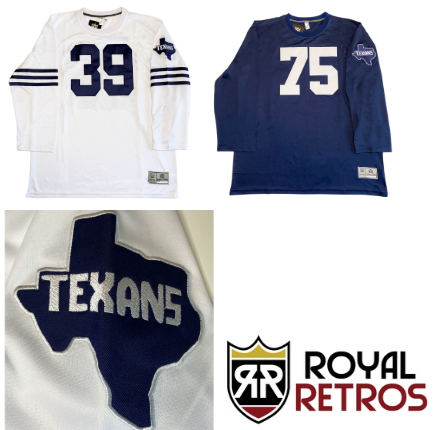
When it comes to Replica Jerseys, we turn to our friends at Royal Retros, who put extraordinary detail into their fully customizable pro football jerseys, including the 1952 Dallas Texans.
Free Customization Included
Any name and number
Heavyweight sewn tackle twill
100% polyester
Honor the rich history of pro football in Dallas in this great jersey from Royal Retros today! (Note: Product page also contains jerseys from the 1960-1963 American Football League Texans)
Things were looking yellow rosy in Texas that spring and summer. NFL owners and Miller thought the Dallas franchise would easily be a huge success.10NFL Owners Welcome Yank’s Transfer to Dallas, United Press via The Pittsburgh Press, Jan. 21, 1952 The city was growing rapidly, and the state was mad for high school and college football. A pro team would fit right in. As early as 1945, the city was mentioned as a possible location for an NFL team11Old Brooklyn Grid Franchise May Become Court Issue, United Press via The Washington Reporter, Dec. 19, 1945, and now Big D was getting its shot.
High hopes at kick-off
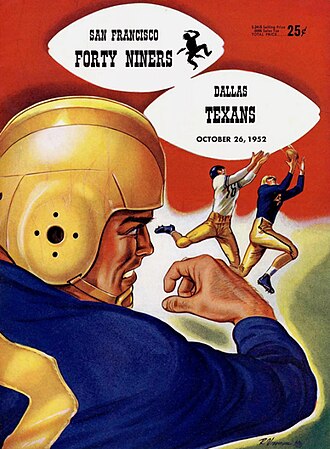
On that late September Sunday, when the Texans opened their first, and only, season at home against the powerful and popular New York Giants, the air rapidly left the balloon. Only 17,000 fans turned out to watch the home team fall 24-6. Only 12,000 showed up the following week to watch the new squad fall to the San Francisco 49ers 37 to 14.
The Texans’ second game was the San Francisco 49ers
When Week 7 of the 1952 season arrived, the Texans found themselves with a record of 0-6 and a home game scheduled against the Los Angeles Rams. Dallas fell 27-6 in front of just 10,000 fans. The following day, Miller was looking for a way out, as he appealed to the unofficial Citizens Council of Dallas for help.12Appeal Issued to Keep Texans in Operation, UP via The Victoria Advocate, Nov. 3, 1952 A plan was devised to raise money by issuing stock in the team. It was also proposed that kids under 16 be admitted to the Cotton Bowl for half price for the team’s remaining home games. Those ideas were quickly discarded, however, and Miller returned the franchise to the league two days later.13Dallas Texans, Pro Football Club, Folds INS via The Rome News-Tribune, Nov. 13, 1952
League runs the team
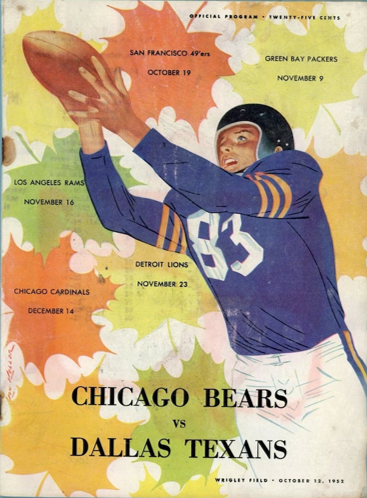
Under league control, the team’s next home game, a match-up with the Chicago Bears, was moved to the Rubber Bowl in Akron at the behest of a local promoter. At first, commissioner Bert Bell declined, but soon changed his mind. He asked only that the game be moved up a few days to Thanksgiving, as the Browns were playing a home game in nearby Cleveland that Sunday. On short notice, only 3,000 fans turned up to watch the Texans get their first and only win in franchise history, 27-23 over the Bears.
They lost the following week in Philadelphia, while the final home game against Detroit was moved to the Motor City. There, the Lions topped the Texans 41-6 in the latter’s last-ever game. Even before the regular season wrapped up, the league had moved quickly to resolve the situation with the franchise.
Looking for a new home
Groups in Houston and Baltimore expressed interest in taking the team. The latter had lost the original Baltimore Colts following the 1950 season, when that franchise, absorbed from the All-America Football Conference, folded outright after just one season in the NFL.14Hopeless Financial Risk, Baltimore Quits Football, AP via The Montreal Gazette, Jan. 19, 1951 On December 3, commissioner Bert Bell challenged Baltimore to sell 15,000 season tickets by January 22, 1953. Fans in Maryland answered the call, and on January 7, Baltimore was awarded a new franchise, marking the return of the Colts to Baltimore.15Baltimore Back In Pro Football, United Press via The St, Joseph Gazette, Nov. 12, 1952 The official announcement came four days later at a press conference held on January 11. As with the Yanks, though, the league issued a new franchise, rather than relocating the Dallas entry, even though the Colts had inherited the Texans’ roster.
Though the Texans had failed spectacularly, folks in the Lone Star State did not give up on the idea of pro football returning to the state. Just five years after the Texans were laid to rest, a young oilman named Lamar Hunt approached the NFL about bringing a team to his hometown of Dallas, either by relocation or expansion.16The Ten-Gallon War: The NFL’s Cowboys, The AFL’s Texans and the Feud for Dallas’s Football Future, p. 5, John Eisenberger, 2012, Houghton Mifflin Harcourt Publishing Company, New York, NY, ISBN 978-0-547-43550-3Hunt did not succeed in landing a new NFL team for Dallas, but the city did get one. Undaunted, the young millionaire simply started his own football league and owned a team in that circuit called the Dallas Texans.
Hear more:
Our friends at the Good Seats Still Available podcast did an episode about the 1952 Dallas Texans. Listen here: