East Coast Hockey League (1991-1999)
Tombstone
Born: July 25, 1991 (Columbus Chill announced)
Suspended Operations: April 12, 1999
Relocated: May 16, 2000 (Reading Royals)
First Game: October 24, 1991 (W, 8-7 OT @Roanoake Valley Rebels)
Last Game: April 11, 1999 (L 2-1 OT @ Chesapeake Icebreakers, First Round, ECHL Playoffs)
Riley Cup/Kelly Cup Championships: None
Arena
Ohio State Fairgrounds Coliseum
Opened: 1918
Seating: 5,800
The Chiller, Dublin, Ohio (Select games)
Opened: 1993
Seating: 400
Marketing
Team Colors: Black and white
Ownership & Affiliation
Owner:
- 1991-1998: Horn Chen
- 1998-1999: SMG and Aramark
President & GM:
- 1991-1998: David Paitson
- 1998-1999: Don Granato
NHL Affiliation:
- 1991-1994: Vancouver Canucks
- 1991-1994, 1995-1999: Chicago Blackhawks
- 1997-1998: Anaheim Mighty Ducks
IHL/AHL Affiliation:
Background
To hockey aficionados, the Columbus Chill are probably one of the best-known minor league hockey teams of all time, perhaps surpassing the fictional Charlestown Chiefs from the 1977 film Slap Shot in name recognition. The team was formed at the dawn of what turned out to be a professional hockey renaissance in North America at both the major and minor league levels.
In the late 1980s,
National Hockey League (NHL) attendance was solid for most of the league’s 21 clubs. Minor league hockey, though, was suffering, particularly in Ohio. In the 1970s, the state had two major league teams and three minor league clubs. In the fall of 1987, there wasn’t a single professional hockey team in the state. Columbus had bade farewell to its last team, the
Columbus Owls of the
International Hockey League (IHL) in 1977.
Hockey gets popular
As interest in the NHL steadily increased across North America, though, so did the fortunes of minor league hockey. The IHL, at the second tier of hockey along with the
AHL, began to move into larger markets, including ones occupied by NHL teams. In 1988, the
East Coast Hockey League (ECHL) formed to occupy the third tier of the sport in North America, similar to AA baseball.
Horn Chen, a Chicago businessman who owned several minor league hockey teams, was awarded a franchise in the ECHL. Initially, his team, led by General Manager David Paitson, set its sights on Cleveland. The city hadn’t had pro hockey since the NHL
Barons left town in 1978 to merge with the
Minnesota North Stars. It was a large sports market with a huge youth hockey scene.
Hello, Cleveland
Unfortunately, there wasn’t a suitable arena for the team to use. The
Richfield Coliseum, where the
WHA Crusaders played between 1974 and 1976 and the NHL Barons skated for two years after that, was available. However, its distance from downtown, something that hindered the two previous hockey teams, made it unattractive, as did the potential cost of a lease.
Cleveland State University (CSU), located downtown, was building a new arena, but informed Horn’s group that the facility would have no ice surface available. Word on the street was that the Gund Brothers, owners of the NBA Cavaliers, were angling for a downtown arena and pressured CSU to exclude the equipment necessary to create a frozen surface. It was thought the Gunds wanted to book events requiring ice, or wanted to bring their own minor league team to town. At the time, they also owned the NHL’s San Jose Sharks. In 1992, the IHL
Muskegon Lumberjacks relocated to Cleveland, where they played at the Richfield Coliseum. In 1994, the
Cleveland Lumberjacks moved to the new arena downtown, which they shared with the Cavs.
A capital idea
Paitson told Chen the team would not be able to play in Cleveland. The group then drew up a short list of cities that might provide a suitable home. Columbus checked most of the boxes, although the area’s aging arena, the
Fairgrounds Coliseum, wasn’t ideal, the city had other things going for it.
Still, the city hadn’t seen a hockey team since the Columbus Owls left for Dayton, and later Grand Rapids, in 1977. The reason they left, ironically, was the inability to secure enough suitable dates at the Coliseum. There was nowhere to go but up for Chen, Paitson, and their new ECHL team.
On July 25, 1991, the team was introduced to the city at a press conference. The Chill name, logo, colors, and uniforms were unveiled to a largely disinterested media who were mostly waiting around for Ohio State University football to resume in a month.
Corner the marketing
Indeed, OSU cast a large shadow over the city, which had a minor league baseball team (the Clippers of the
International League) and a minor league basketball team (the
Horizon of the
Continental Basketball Association). The Clippers drew well at the time, topping the IL in attendance with nearly 8,000 fans a game thanks to a playoff run that year. But neither the Clippers nor the Horizon captured the attention of the city’s sports fans like the University’s athletic teams.
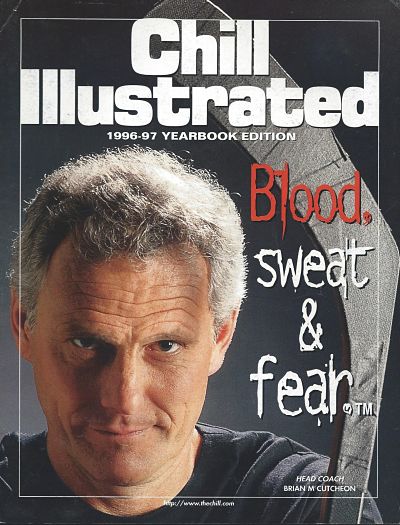
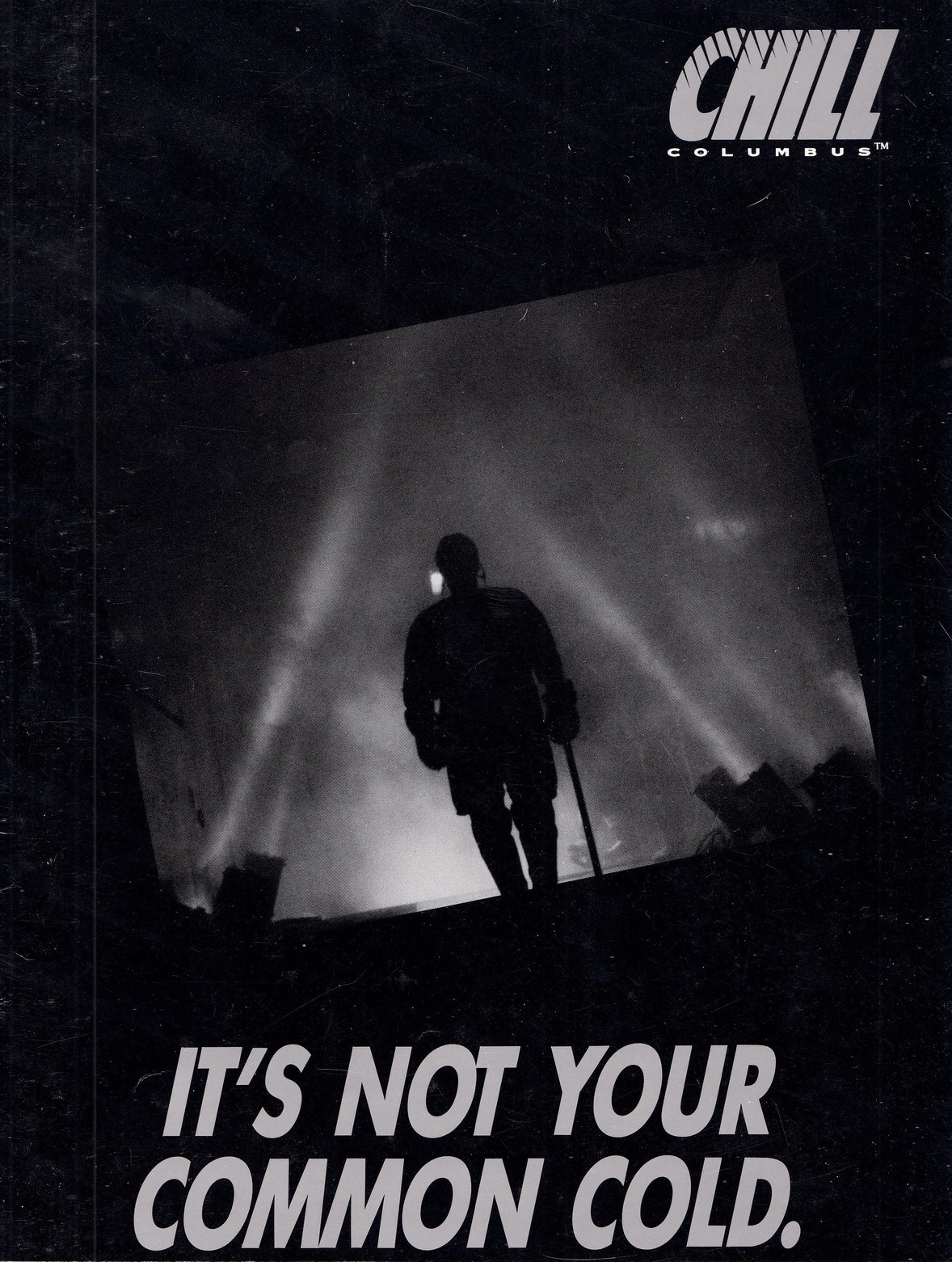
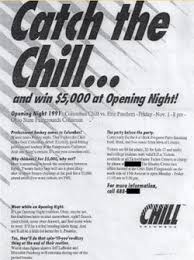
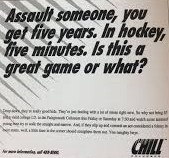
Undeterred, The Chill marched into their first season, propelled by a bold marketing campaign. Typical of the time, print ads featured edgy headlines such as “Assault someone, you get five minutes. In hockey, five minutes? Is this a great game or what?” There were dozens of others.
At one point, Paitson received a phone call from a professor of marketing at OSU, berating the team’s media campaign. The prof informed the GM that his class was debating the ads endlessly and had several criticisms. A campus full of young people was talking about his hockey team? Paitson knew he was on the right track.
Breaking the ice
The team’s home opener on October 10, 1991, drew 6,298 fans to the Coliseum, which only had a capacity of 5,700. The team’s marketing efforts gained attention not just in Columbus but nationwide. In January, the team started a streak of 83 straight sellouts, a minor league record.
Columbus had seen solid sports marketing before. The Clippers, in their inaugural season in 1977, won the John H. Johnson President’s Award from the IL for their promotional efforts. The Chill, though, was relentless. Where the Owls had failed back in the 1970s, the Chill were generating talk of the NHL coming to town in only their first season.
To cement their fan base, the Chill not only continued to market the team aggressively, but they also decided to create knowledgeable hockey fans. In 1993, the team opened its own ice facility in suburban Dublin, the first minor league team ever to do so. The facility hosted youth leagues, ice skating, and programs that taught fans to play the game. Kids who participated in youth hockey programs jumped nearly tenfold during the team’s tenure in the city.
In their third season, the Chill made the playoffs. The local NBC affiliate pre-empted network programming to carry the team’s first postseason contest. The Chill beat the Johnstown Chiefs (the real-life inspiration for the Slap Shot team). The team made the playoffs the next three seasons and continued to pack fans into the Fairgrounds Coliseum. Yet their success was sowing the seeds of their demise.
If success doesn’t kill you…
In December 1994, the city initiated a study on the feasibility of building a downtown arena with the Chill, or possibly an NHL team, as its primary tenant. In January of 1996, Chill GM Paitson joined a delegation that went to New York to express interest in an NHL expansion franchise for Columbus.
The city put forth a bond issue, which called for a taxpayer-funded downtown arena. If that passed, the NHL franchise was all but guaranteed. Issue 1 failed massively. Unlike voters in Cleveland and Cincinnati, Columbus’ electorate balked at the idea of building a facility for some millionaire to put his pro sports team, no matter how much they loved the Chill and the idea of finally getting a big league team. Just over three weeks later, Nationwide Reality Inc. announced that it would finance the $125 million project. Three weeks after that, the NHL awarded an expansion franchise to Columbus. Local businessman John McConnell was identified as the principal owner.
Chen received a minority stake in the new team as the storied history of the Columbus Chill began to wind down. Attendance dipped slightly in the club’s final two seasons but remained strong by ECHL standards. On Easter Sunday, April 4, 1999, the Chill played its final regular-season home game in front of 5,846 fans. Dubbed the “Last Call,” the hometown team defeated the Dayton Bombers 5-0.
Last call and legacy
Following the Chill’s exit from the playoffs via a 2-1 OT loss to the Chesapeake Icebreakers on April 11, 1999, the team suspended operations. The franchise remained dormant, or frozen, if you will, until the spring of 2000, when it was moved to Reading, PA. SMG, which owned the franchise, sold a stake in it to the NHL’s L.A. Kings, who wanted a farm team in the ECHL. SMG then signed a deal to run a new arena in Reading. There, the team became the Reading Royals, who made their debut in 2001 and are still in existence.
The Blue Jackets debuted on October 7, 2000, at home in their brand-new arena against the Chicago Blackhawks. It marked the arrival of big-league hockey to Columbus, but did not erase the memories of the city’s departed, but still beloved, minor league squad.
Listen up:
Former Chill GM and President Dave Paitson spoke to our friends at the Good Seats Still Available podcast in 2020:
##