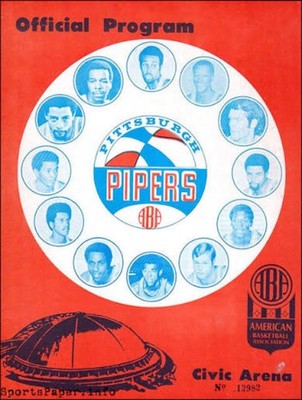
American Basketball Association (1967-1968, 1969-1970)
Tombstone
Born: February 2, 1967 (ABA founding franchise)
Moved: June 28, 1968 Minnesota Pipers
Returned: July 21, 1969
Rebranded: July 23, 1970 (Pittsburgh Condors)
First Game: October 23, 1967 (W 110-107 @ New Jersey Americans)
Last Game: April, 15, 1970 (W 132-110 vs. Carolina Cougars)
ABA Championships: 1968
Arena
Pittsburgh Civic Arena(13,500)
Opened: September, 17, 1961
Demolished: September 26, 2011
Marketing
Team Colors: TruColor.netBlue, Gold, White
Ownership
Owners:
1967-1969: Gabe Rubin and Jason Shapiro
1970: Airport Services Inc. (Haven Industries subsidiary)
Background
The Pittsburgh Pipers were charter members of the American Basketball Association (ABA) in 1967, and spent four seasons playing in two different cities under three different names. Still, they lasted longer than any of the city’s previous pro cage teams, of which there were four.
Earlier pro basketball teams in Pittsburgh
Undeterred by the failure of three previous teams, the NBA became interested in Pittsburgh as the location for an expansion franchise in 1960, as did a new league called the
American Basketball League (ABL). The latter was largely bankrolled by Abe Saperstein, the promoter who owned the Harlem Globetrotters. Both leagues were attracted by the city’s new arena, then under construction.
The ABL welcomed the Pittsburgh franchise, later named the
Rens, as a charter member in May 1960 to begin play in 1961. Undaunted, the NBA awarded an expansion franchise to Pittsburgh on January 17, 1961, only to have the team’s owner back out the next day. The Rens, along with the rest of the ABL, went out of business halfway through their second season on December 30, 1962.
NBA dreams for Pittsburgh
The NBA and Pittsburgh did not give up on each other, though. In June of 1966, the city, along with Cleveland, was named as a possible location for expansion. To grease the wheels, Jason Shapiro arranged to have the cross-state Philadelphia 76ers play six regular-season games in Pittsburgh. Shapiro’s family owned the National Record Mart music chain.
The NBA, however, selected Seattle for expansionleaving only one slot open. That was quickly grabbed by San Diego. Soon after, ABA organizers contacted Shapiro and Gabe Rubin. The latter had amassed a small fortune by opening a string of drive-in movie theaters in Western Pennsylvania and later bought the Penn Theatre and Heinz Hall downtown.
Pittsburgh joins the ABA
Rubin was keen to throw in with the ABA, seeing the $30,000 entrance fee as a bargain over the $2.25 million being sought by the NBA. On February 2, 1967, Pittsburgh was announced as one of the participating cities in the new league. On June 13, the team was nicknamed the Pipers. Three days before that, the team signed Joe Strawder away from the NBA’s Detroit Pistons. Unfortunately, the deal fell through when Strawder re-signed with the Pistons on September 22.
A big signing that did stick was that of Connie Hawkins, an extremely talented player who had been barred from the NBA after being mixed up in a point-shaving scandal while in college. Even though the facts revealed it was impossible for him to have participated (he was ineligible to play varsity sports at the time of the illegal activity), the NBA stood firm. Hawkins wound up playing in the ABL for the Rens, where he earned MVP honors in his rookie season. He caught on with the Harlem Globetrotters after the Rens and the ABL went under. The ABA, and its commissioner, George Mikan, after some deliberation, gave Hawkins the greenlight. He signed with the Pipers on April 27, 1967, making him the team’s first player.
Pittsburgh Pipers championship season
The Pipers opened their inaugural season with a 110 to 107 win over the
New Jersey Americans. The next night, 5,719 fans came through the turnstiles at the Civic Arena for the home opener, a 104-86 loss to the Minnesota Muskies.
Led by Hawkins, along with Art Heyman, Charlie Williams, and Chico Vaughn, the Pipers finished first in the ABA’s Eastern Division. Sadly, few fans witnessed their triumphant march. Most nights, only 1,400 or so would show up. A December 5th contest against the
Denver Rockets drew only 698 paying customers. Still, they made it to the ABA Championship where they faced the New Orleans Buccaneers.
They topped the Bucs in seven games, with 11,457 in attendance at the Civic Arena to watch the home team capture the title, 122-113, on May 4, 1968. The team wouldn’t receive championship rings until some 35 years later, when surviving teammates got together and bought their own.
Move to Minnesota
Less than two months after capturing the title, Rubin, oddly, partnered with Minnesota attorney Bill Erickson and announced the team was moving to Minnesota. That market had just been abandoned by fellow ABA squad the Minnesota Muskies, whom the Pipers had beaten in the second round of the playoffs. The Muskies packed their bags on May 24 and headed to South Florida.
The relocation of the Pipers started an odd trend in the ABA, as the league’s second champions, the Oakland Oaks, moved to Washington, D.C. after capturing the title in 1969. In his book Breaking the Game Wide Open, league co-founder Gary Davidson wrote sarcastically of the shifts, “Naturally, it is very important to move your champion to a new city every season, it seems.”
The Pipers didn’t fare much better than the Muskies in the Twin Cities as they notched a record of 36-42. Their record was still good enough to make the playoffs, but they lost to The Floridians (the former Muskies) in the first round.
And back again
On July 21, 1969, Rubin decided to move the team back to the Steel City, where they once again became the Pittsburgh Pipers. Things went from bad to worse, though, as the team finished with a record of 29-55, out of the playoffs, and unable to draw even 1,500 fans a night to the Civic Arena.
Rubin had had enough, and on April 21, a week after the end of the regular season, he sold the team to Airport Services Inc., a subsidiary of New Jersey-based Haven Industries. A few months later, the team was renamed the Pittsburgh Condors and hung on for two more seasons before folding on June 13, 1972.
Links
American Basketball Association Media Guides
American Basketball Association Programs
###