

All-America Football Conference (1946-1949)
Tombstone
Born: September 2, 19441All-America Pro Grid Loop Grid Loop Enrolls Seven Clubs With Rich Backing, UP via The Pittsburgh Press, Sep. 3, 1944
Folded: December 9, 19492A-A, NFL Merge, End Costly 4-Year Grid War, AP via The Herald-Journal, Dec. 10, 1949
First Game: September 8, 1946(L 27-14 vs. Brooklyn Dodgers)
Last Game: December 4, 1949(L 31-21 @ Cleveland Browns, AAFC Divisional Playoff game)
AAFC Championships: None
Stadium
Stadium: Civic Stadium
Opened: October 16, 19373Tulane Wins By One Point, UP via The Berkeley Gazette, Oct. 16, 1937
Demolished: Sep. 9, 19894 Column: From old days to New Era, home of the Bills has a Rich legacy, via Tuscon.com, Jul. 20, 2020
Branding
Team Colors:
Royal Blue, Silver, White (Source: TruColor.net)
Ownership
Owners:
James Breuil
Background
The original Buffalo Bills football team, related to the current NFL franchise in name only, began as a charter member of the All-America Football Conference (AAFC) in 1946. It wasn’t the city’s first foray into pro football.
Indeed, Buffalo was represented in the inaugural season of the American Professional Football Association (APFA) in 1920 by a squad called the All-Americans. In 1922, the APFA became the National Football League (NFL). In 1924, the Buffalo franchise changed its name to Bisons. In 1926, they became the Rangers, before going back to the Bisons in 1927. They took 1928 off, returned in 1929, and folded at the end of that season.
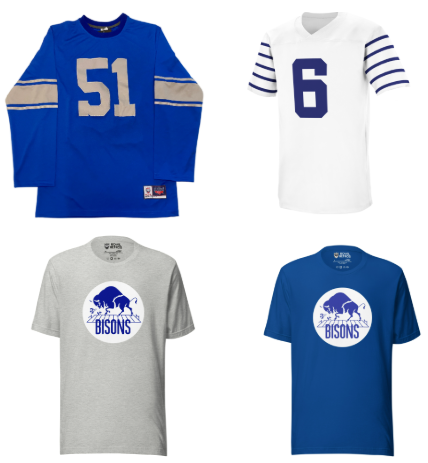
Pro football didn’t return to Buffalo until 1940, when the third American Football League was established to challenge the NFL. Buffalo was represented by a team called the Indians in the league’s first season. They changed their name to the Tigers in 1941. The league went out of business shortly after the Japanese attack on Pearl Harbor and the subsequent entry of the U.S. into World War II, as the conflict greatly reduced the pool of football talent. The established NFL could barely keep its rosters stocked. In 1943, the Cleveland Rams took a year off, and Pittsburgh and Philadelphia merged for one season. The following year, Pittsburgh combined with the Chicago Cardinals for the 1944 season.
A rival to the NFL
However, in September of that year, just three months after the D-Day invasion, Chicago Tribune sports editor Arch Ward established the All-America Football Conference (AAFC). Ward, and the owners he lined up, envisioned a system similar to Major League Baseball, with two separate leagues that capped off each season with a championship game played between each circuit’s top team. The NFL was not keen on the new competition.
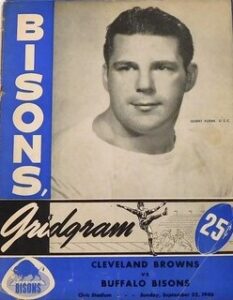
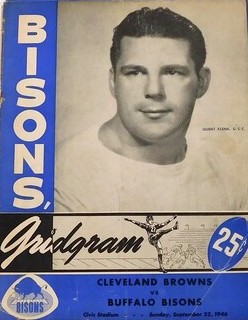
Initially, seven of the eventual eight AAFC cities were announced, including Buffalo. The plan was to start in 1945, but that was later pushed back to 1946. The Buffalo club, owned by local oil company magnate James Breuil, took the name Bisons, a moniker used by the city’s minor league baseball, minor league hockey, and pro basketball teams. On September 8, 1946, the Bisons debuted against the Brooklyn Dodgers at home in Buffalo’s Civic Stadium. The home team lost 27-14 before 25,489 fans. Things didn’t improve much, and the Bisons finished with a record of 3-10-1.
 New name
In the spring of 1947, the team’s management decided the club needed a nickname of its own and held a name-the-team contest. The winning entry, announced on June 16, was Bills, in honor of William “Buffalo Bill” Cody, the famed frontiersman, soldier, and bison hunter. Cody had no particular connection to the city of Buffalo, though he lived in nearby Rochester for a few years. James Dyson, the fan who had submitted the name, told club officials he planned to use the accompanying prize money, $500, for a vacation and to pay for an operation for his wife.5Bisons Change Nick-Name, AP via The Montreal Gazette, Jun. 17, 1947
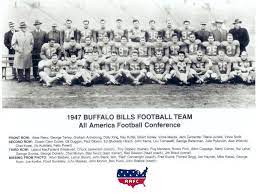 The new-look, renamed Buffalo Bills improved to 8-4-2 in 1947, good for second place in the AAFC East division, thanks mostly to a rookie, former Notre Dame star quarterback George Ratterman. In 1948, they finished tied for first with Baltimore, each posting a 7-7 record. That forced a playoff game, won by the Bills 28-17 in Baltimore. In the championship, though, the Bills fell to league juggernaut Cleveland, who captured their third straight title, 49-7.
The football war ends
In 1949, the AAFC was down to seven teams as the Brooklyn Dodgers merged with the New York Yankees. Instead of two four-team divisions, the league was now organized as a single seven-team table. As such, the four top teams would make the playoffs and play in a postseason tournament. Buffalo grabbed the last playoff spot with a record of 5-5-2. However, they succumbed once again to the Browns, this time in the opening round, by a score of 37-21.
At the end of the 1949 season things came to a head. The two leagues had fought a costly four-year battle for fans, and more importantly, players, which drove up operating costs across both circuits. As early as September, rumors of a merger were appearing in the press. As the season wore on, though, it increasingly looked like it was going to be the absorption of a few AAFC teams by the NFL, with the remaining clubs from the rebel league going out of business.
The AAFC made a brave last stand on November 30, when its commissioner O.O. Kessing stated to the United Press (UP) that the league would have eight teams operating for the 1950 season.6AAC To Have Eight Teams, AP via The Daytona Beach Morning Journal, Nov. 30, 1949 He was almost certainly referring to Houston as the new member, as oilman Glenn McCarthy was expected to be granted a franchise at the AAFC meeting in December. Furthermore, Kessing told the UP that the AAFC was not interested in a merger with the NFL.
Buffalo left out in the cold
Just over a week later, likely unbeknownst to Kessing, NFL commissioner Bert Bell met with Browns minority partner Dan Sherby, and the football Yankees team attorney, Arthur Friedlund. The three hammered out the merger, which Bell announced on December 9. As part of the deal, Bills owner Breuil acquired a minority stake in the Browns. The Chicago Hornets, Los Angeles Dons, and New York Yankees would be merged into the NFL teams in their respective cities. The Browns, San Francisco 49ers, and, oddly, the Baltimore Colts would join the NFL.
People were a bit stunned by that last one. The Colts finished 1-11 in 1949 and were on shaky financial ground. Their final home game against, somewhat ironically, the Bills, drew just over 16,000 fans. Meanwhile, Buffalo’s average attendance in 1949 was 26,000, some 3,000 fans a game better than the NFL average.
As far as Buffalo not making it, though, blame Breuil. He was more than happy to gain a stake in the Browns and fold the Bills, who he claimed had cost him over $700,000 in the AAFC’s four-year existence.
One last chance
Undaunted, a group of five local businessmen petitioned the NFL (at this point briefly called the National-American Football League, or NAFL) to allow Buffalo in for the 1950 season. Glenn McCarthy, meanwhile, kept up his campaign to get a franchise for Houston.7National-American Football League to Consider Buffalo, Houston, AP via The Lewiston Daily Sun, Jan. 6, 1950 On January 19, 1950, it was announced that Buffalo was in as the 14th NAFL team “provided a satisfactory schedule could be drawn up,” according to press reports. Houston was out. However, just five days later, the teams playing in 1950 were officially announced, and Buffalo was not one of them.
At a meeting before the announcement, Bell offered the Buffalo group one last opportunity to sway the other owners. Afterwards, a vote was taken. The first six ballots on Buffalo’s admission were “yes” votes. Los Angeles Rams owner Dan Reeves, though, voted “no.” Since unanimous approval was needed, the Bills were out.
The group behind the new Buffalo franchise stayed together for a few more weeks and briefly entertained the idea of joining a new football league based in Canada.8Buffalo Might Join Pro Loop, CP via The Leader Post, Feb. 2, 1950 This, of course, was eight years before that country’s Interprovincial Rugby Football Union (The Big Four) and the Western Interprovincial Football Union formed the Canadian Football League (CFL).
The league never materialized, and the “new” Bills organization packed it in. Nine years later, on November 3, 1959, pro football returned to Buffalo when Ralph Wilson, who owned a minority stake in the NFL’s Detroit Lions, bought a franchise in Lamar Hunt’s new American Football League (AFL).9Franchise for Buffalo in New Pro Grid Loop, UP via The Meriden Record, Nov. 3, 1959 At first, Wilson thought about placing his team in Miami, but was unable to get a lease on the Orange Bowl. Harry Wismer, owner of the AFL’s New York franchise, suggested Buffalo would be a great market, and Wilson agreed. On November 30, he announced his team would be called the Buffalo Bills in a definitive nod to the city’s beloved AAFC squad.10Important Dates in Bills History: Nov. 30, 1959. Bills team name adopted, Buffalo Bills website, Nov. 29, 2016
Watch
Buffalo Bills 1946 Highlight real via On This Day in Professional Football:
Links
All-America Football Conference Programs
##