
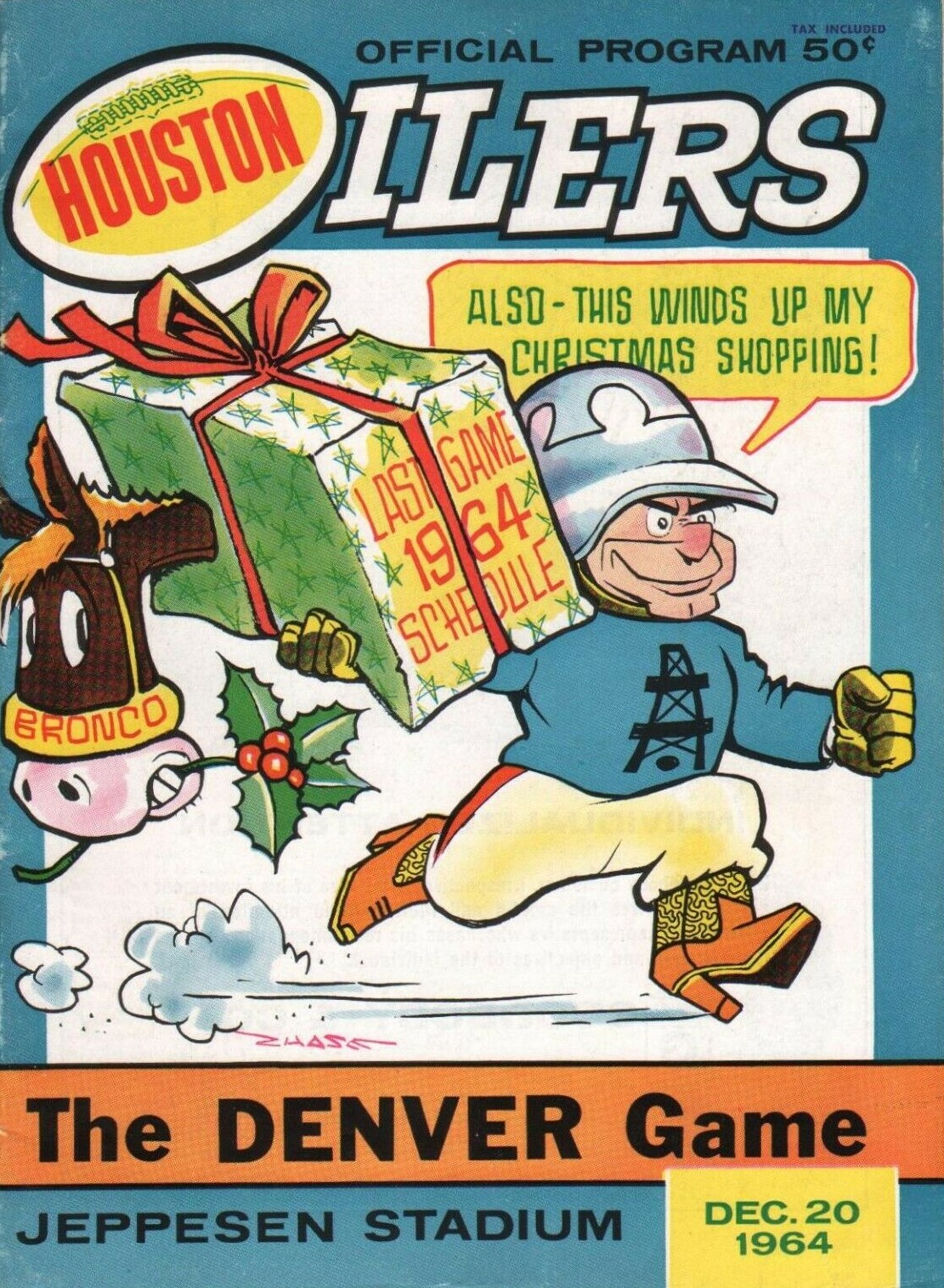
American Football League/National Football League (1960-1996)
Tombstone
Born: August 1, 1959 (AFL founding franchise)1New Pro Circuit Named American Football Loop, AP via The Lawrence Daily Journal-World, Aug. 1, 1959
Relocated: November 16, 1995 (to Nashville as, eventually, the Tennessee Titans)2Oilers Making the Move, AP via The Times-Union, Warsaw, IN, Nov. 17, 1995
First Game: September 11, 1960 (W 37-22 @ Oakland)
Last Game: December 22, 1996 (W 24-21 @ Baltimore Ravens)
AFL Championships: 1960, 1961
Stadium
Jeppesen Stadium (1960-1964)
Opened: 1942
Demolished: 2012
Rice Stadium (1965-1967)
Opened: 1950
Houston Astrodome (1968-1996)
Opened: April 9, 1965
Closed: 2008
Marketing
Team Colors:
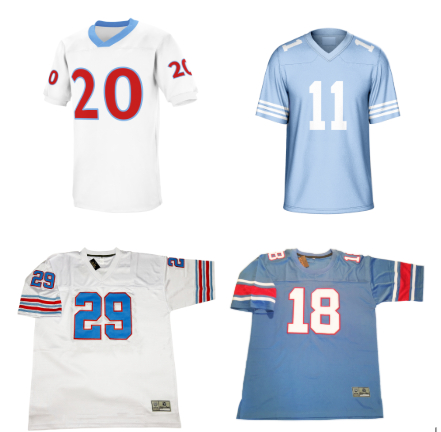
Columbia Blue, Red, and White (1960-65)
Columbia Blue, Red, Silver, and White (1966-1971)
Columbia Blue, Red, and White (1972-1974)
Columbia Blue, Scarlet Red, and White (1975-1996)3TruColors.net
Ownership
Owner: Bud Adams
Background
As early as 1949, Houston was trying to land a professional football team. At first, super wealthy oilman Glenn McCarthy tried to purchase the Cleveland Browns, then members of the All-America Football Conference (AAFC), a direct rival of the established National Football League (NFL).4 The League that Didn’t Exist: The History of the All-America Football Conference 1046-1949, Gary Webster, 2019, p.188, McFarland That effort failed. However, McCarthy landed an AAFC expansion franchise in November of that year, with hopes of being ready for the 1950 season.5“Oilman McCarthy May Join AAFC Set-Up,” INS via The Reading Eagle, Nov. 19, 1949 That team never took the field. Just a month after being given the green light, the AAFC agreed to merge with the NFL and sent three of its surviving seven teams to the older league, while the remaining four were disbanded.
Big plans for Houston
McCarthy, who had envisioned his team playing in a state-of-the-art, 100,000-seat domed stadium, immediately turned his attention to the NFL.6“National-American Football League Debates Buffalo and Houston Bids,” AP via The Lewiston Daily Sun, Lewiston, ME, Jan. 19, 1950 Along with representatives from Buffalo, he lobbied the older league to grant him an expansion franchise. Buffalo was one of the cities left out of the AAFC merger.
In attempt to expedite his acceptance, McCarthy proposed buying the assets of the AAFC’s Chicago Hornets, also left out of the merger, to form his team in Houston.7“McCarthy May Finance League,” AP via The Dispatch, Lexington, NC, Jan. 5, 1950 The NFL, though, dragged its feet on adding more clubs. One of the former AAFC teams, the Baltimore Colts, were not in great shape, nor were the New York Yanks. The Colts (no relation to the current Colts team) folded after just one season in the NFL. Ted Collins, owner of the Yanks, sold his franchise back to the NFL following the 1952 season.8“NFL Buys Yanks Franchise for Transfer to Dallas,” UP via The Pittsburgh Press, Jan. 20, 1952 The league then sold it to a group from Texas who formed the Dallas Texans.
McCarthy had attempted to purchase the assets of the Yanks and form a team in Houston, but the Dallas group won out.9“Grid Yanks Sold: Goes to Dallas for ’52,” AP via The St. Petersburg Times, Jan. 21, 1952 McCarthy kept at it, though. That is, until the Texans started to falter. A disaster on the field and at the gate, the team’s owner returned the franchise to the league after the seventh week of the 1952 season. McCarthy was ready to step in and move the team to Houston, but Rice University, whose stadium the club would have to use until their facility was built, got skittish and would not offer a lease.10“Deal May Backfire,” Montreal Gazette, Nov. 21, 1952 At that point, McCarthy gave up.
Your bud, Bud
Seven years later, fellow Houston oilman Bud Adams took a trip to Miami to meet with Violet Bidwell Wolfner, owner of the Chicago Cardinals, at her winter home. Adams wanted to discuss the possibility of buying into, or purchasing outright, the team and moving it to Houston. The Wolfners declined.
Adams then met with “Papa Bear” George Halas, the Chicago Bears owner and head of the NFL expansion committee. Halas, however, was not keen on adding any new franchises to the 12-team NFL, particularly after the debacle in Dallas just a few years earlier.
A few weeks later, Adams got a call from another oilman (it was all oilmen in Texas back then) named Lamar Hunt Jr. The Dallas native had also tried to buy the Cardinals and approached the NFL about expansion with similar results. Hunt, after his meeting with Halas, drew up a plan for a new football league and wanted to know if Adams was interested. His Houston counterpart indicated he was.
Hunt announced the formation of the American Football League (AFL) on August 1, 1959.11“New Pro Circuit Named American Football Loop,” AP via The Lawrence Journal World, Lawrence, KS, Aug. 1, 1959 The official launch came a few weeks later at an August 22 press conference. The NFL responded with a two-pronged attack. First, Halas and the older league found someone to purchase an expansion team for Dallas. Then they offered Adams a team in Houston. Adams declined and decided to stick with Hunt and the AFL.
Shots fired
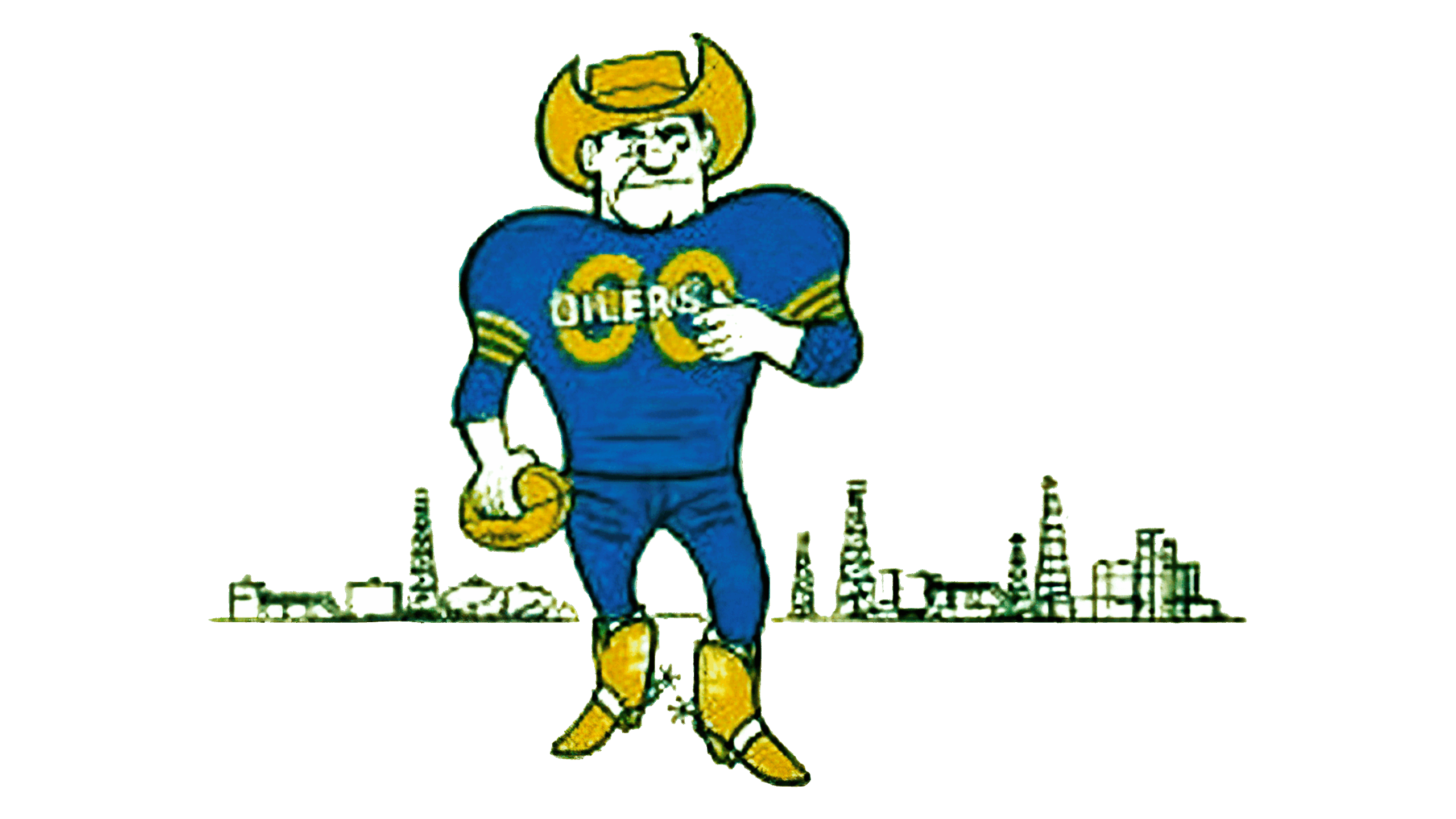
On October 30, 1959, Adams announced his team would be called the Houston Oilers.12“Houston Oilers Out for Big-Name Coach,”AP via The Lewiston Daily Sun, Lewiston, ME, Oct. 31, 1959 The new team wasted no time in taking it to the NFL, signing LSU All-American halfback Billy Cannon, despite the rookie already having signed with the NFL’s Rams. The courts ruled in favor of the AFL and the Oilers. Adams further tweaked Halas and the NFL by signing the Chicago Bears quarterback George Blanda.13Remember the AFL, Dave Steidel, pp-57-58, Clerisy Publishing, 2008
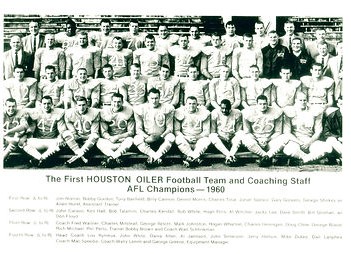
The Oilers won the first two AFL championships, as they downed the Los Angeles Chargers in 1960 by a score of 24 to 16 and then repeated that feat in 1961, topping the Chargers, who had since moved to San Diego, 10 to 3. They made their third championship appearance in a row in 1962 but lost to Hunt’s Dallas Texans in a two-overtime thriller, 20-17. It was the longest pro football game ever played up to that time.
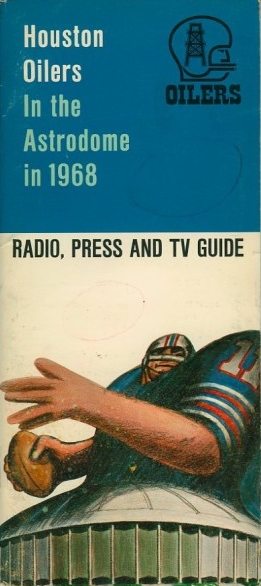
The team fell on hard times after that. In 1964, after five seasons playing in Jeppensen Stadium, essentially a very nice high school stadium, the Oilers moved into Rice Stadium. Though the Astrodome opened in spring 1962, the Oilers didn’t start playing there until 1968, two years after it was announced that the AFL and NFL would merge for the 1970 season.
Hard times
The Oilers continued to struggle in the combined league. In 1972, they bottomed out with a record of 1 and 13 record, before notching the exact same mark in 1973. In 1975, they finished 10-4 but missed the playoffs by one game as the Cincinnati Bengals got the lone Wild Card spot with an 11-3 record.
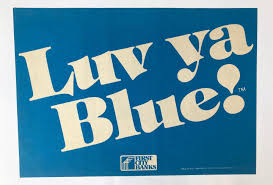
The late 70s were much better, though. Led by quarterback Dan Pastorini, running back Earl Campbell, and wide receiver Billy “White Shoes” Johnson, the team made it to the playoffs three straight years starting in 1978. It was the days of the catchy “Houston Oilers, Number One,” fight song and “Luv Ya’ Blue” signs all over the Astrodome. They made back-to-back appearances in the AFC Championship Game (following the 1978 and 1979 seasons) but lost both times to the Pittsburgh Steelers.
They put a string of seven straight postseason appearances together starting in 1987, but still never managed to make it to the Super Bowl. Indeed, they were one of only three teams in existence at the time of the merger to not make it to the Big Game.
Things were going pretty well on the field, but off the turf, Adams battled with Houston officials over the antiquated Astrodome. He threatened to move the team to Jacksonville, but relented when Houston agreed to make upgrades to the Eighth Wonder of the World.14“Jacksonville Left at the Altar Again,” AP via The Lakeland Ledger, Lakeland, FL., Oct. 27, 1987
Back on the gridiron, the Oilers made NFL history by blowing a 32-point lead to the Buffalo Bills in a Wild Card playoff game played on January 3, 1993. The Bills won 41 to 38. The Oilers came back to win the division in 1993 with a record 12-4, but lost to Kansas City in the Divisional round.
They fell to 2-14 the following year, as the wheels started coming off. Adams, meanwhile, lobbied for an entirely new stadium, despite the improvements to the Astrodome. When it became clear that wasn’t going to happen, Adams began contacting other cities.
He eventually found a willing suitor in Nashville. On November 16, 1995, just 10 days after Art Modell announced the relocation of the Browns to Baltimore, Adams publicly acknowledged his intent to move his team to Tennessee’s capital.15“Oilers Making the Move,” AP via The Times-Union, Warsaw, IN, Nov. 17, 1995 While fans in Cleveland and around the country were apoplectic over the Browns’ move to Baltimore, the Oilers’ shift was viewed with a shrug, even by the fans in Houston.
While rallies attended by thousands of people were held in Cleveland, only 65 folks showed up in Houston to protest the Oilers’ move.16“Oilers’ Rally is a Bust,” AP via The Victoria Advocate, Dec. 7, 1995 Indeed, fans of the Browns’ arch rivals, the Pittsburgh Steelers, came to Cleveland’s aid as thousands of fans in the Steel City wore arm bands in support of their turnpike nemesis during a game between the two teams featured on Monday Night Football shortly after the news broke.17“Pittsburghers to Support Cleveland,” The News, Nov. 9, 1996
The Oilers, meanwhile, put themselves in a pickle. They couldn’t move until their lease ran out following the 1997 season, meaning two lame-duck campaigns in Texas. In 1996, the Oilers managed to top the 30,000 mark in attendance twice. In May 1997, the Oilers were let out of their lease and allowed to move to the Volunteer State. There was only one snag: They didn’t have a stadium to move into in Nashville.
As such, they rebranded as the Tennessee Oilers and moved, temporarily, to Memphis. They played at the Liberty Bowl, also known as Memphis Memorial Stadium, while their new place was being built in the heart of Music City. The folks in Memphis reacted to the arrival of the Oilers with a mixture of disdain and indifference.
Memphis had been home to two successful teams in rebel leagues, starting in 1974 with the Southmen of the World Football League (WFL). While the WFL itself wasn’t taken all that seriously, the Southmen drew well and were one of the best teams in the league. In 1984, Memphis received an expansion franchise called the Showboats in the United States Football League (USFL). They played for two seasons before that league was forced out of business in 1986. The Showboats finished in the middle in attendance in their first season but were number five in 1985, drawing an average of over 30,000 fans per game to the Liberty Bowl.
In 1992, thanks in part to the success of the Showboats, Memphis was a finalist for one of two NFL expansion teams to be awarded that year, though the league wouldn’t decide until a year later. Memphis was denied, and that left the fans fuming. The Oilers showing up just to sleep on the sofa until they could move to Nashville was just insulting.
The team averaged just 28,000 fans per game at the Liberty Bowl, by far the lowest in the league that year. The Oilers cut their planned two-year stay short, packed their bags, and headed up I-40 to Nashville. There they played at Vanderbilt Stadium, which only had a capacity of 40,000. However, it was determined that a full house there looked a lot better than the Liberty Bowl at one-third capacity. Oddly, the Oilers only averaged 37,000 fans a game in their first season in Music City. Toward the end of that first campaign in Nashville, on November 14, 1998, Adams announced that the team would be called the Tennessee Titans.
A year earlier, Bob McNair assembled a group of investors that would eventually be awarded an expansion franchise for Houston. It became official in October 1999, as Houston outbid Los Angeles for the 32nd NFL franchise. It was an extraordinary accomplishment, considering L.A., the country’s second-largest media market, had been without pro football for five years following the departure in 1995 of both the Rams and Raiders.
On September 6, 2000, owner Bob McNair announced that the new team would be called the Houston Texans.18NFL, via Knight News Services,” The Toledo Blade, Sep. 7, 2007 The nickname won out over Stallions, Bobcats, Wildcatters, and Apollos. Texans, of course, was also the former nickname of the Kansas City Chiefs when they played in Dallas from 1960 to 1963. Houston Texans was also the name of the city’s entry in the WFL in the 70s.
The new Texans had the usual expansion team challenges, but in 2011, in their tenth season, they won the AFC South and have been regular participants in the postseason ever since.
Houston Oilers Fight Song (“Houston Oilers, #1”)
Our friends at the Good Seats Still Available podcast did an episode on the Houston Oilers, with special guest Dan Pastorini: