
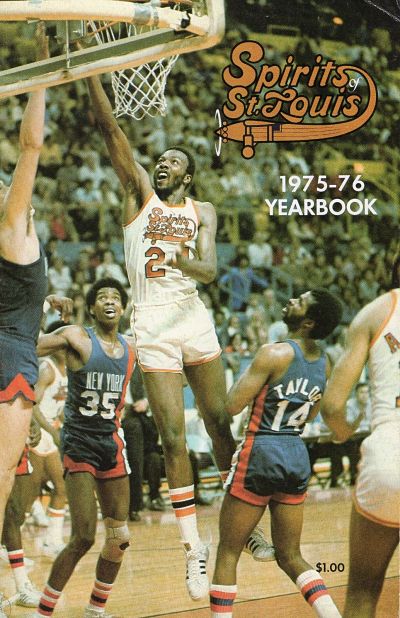
American Basketball Association (1974-1976)
Born: July 16, 1974 (The Carolina Cougars relocate to St. Louis, MO)1Sportswhirl, The AP via The Toledo Blade, Jul. 17, 1974
Folded: June 17, 19762Four Teams Join NBA, UPI via The Middlesboro Daily News, Jun. 18, 1974
First Game: October 18, 1974 (L 97-92 vs. Memphis Sounds)
Last Game: April 6, 1976 (L 120-116 @ Virginia Squires)
Arena: St. Louis Arena (18,000)31974-75 Sporting News ABA Official Guide
Team Colors: Burnt Orange, Silver & Black41974-75 Sporting News ABA Official Guide
Owners: Daniel Silna, Ozzie Silna, Donald Schupak & Harry Weltman
ABA Championships: None
Background
The Spirits of St. Louis played just two losing seasons in the defunct American Basketball Association during the mid-1970’s. The team was never particularly successful in the standings or popular at the box office. Nevertheless, the Spirits retain a dedicated cult following thanks to a fantastically talented collection of players and an outrageous deathbed settlement with the NBA that may just be the greatest financial deal in the history of professional sports.
The Spirits were born in the spring of 1974. Brothers Ozzie and Daniel Silna, polyester manufacturers from New Jersey, purchased the ABA’s Carolina Cougars franchise for a reported $1.5 million. They moved the Cougars to St. Louis, then the largest TV market in the country without pro basketball.5Burke, Monte. “Revisiting ‘The Greatest Sports Deal Of All Time'”. Forbes. May 12, 2011 The NBA had abandoned the city six years earlier when the St. Louis Hawks moved to Atlanta.
Good News & Bad News for St. Louis Fans
The Carolina Cougars were a strong team in the ABA, but few of the Cougars made the move with the team to Missouri. Among the losses was the former All-NBA small forward Billy Cunningham, who famously jumped from the NBA’s Philadelphia 76ers to the Cougars in 1972 and promptly won the league’s 1973 Most Valuable Player award. Cunningham returned to the 76ers in the fall of 1974 after two ABA seasons.
The best player to come over from Carolina was forward Joe Caldwell, a former U.S. Olympian and an All-Star in both the NBA and ABA. But Caldwell’s time would be short and mired in controversy.
The Spirits team that took the floor in October 1974 instead featured a quartet of fascinating rookies. There were the twin big men Marvin “Bad News” Barnes out of Providence College and Maurice Lucas of Marquette. Both were 1974 NBA 1st round draft picks – Barnes went 2nd overall – and both elected to sign with the Spirits.
Guard/forward Gus Gerard played all 84 games and would join Barnes and Lucas on the ABA’s All-Rookie Team for the 1974-75 season. Barnes would earn ABA Rookie-of-the-Year honors along with a reputation for erratic behavior.
The fourth rookie was New York City playground legend Fly Williams by way of Tennessee’s Austin Peay University. Williams averaged 9.4 points off the bench for the Spirits, but he was cut at the end of the season and never played another game of top flight pro basketball.
Final Season
 The ABA’s ninth season in the fall of 1975-76 got off to a brutal start. The league’s perpetually troubled Memphis franchise moved to Baltimore, adopted the name “Hustlers” which sportswriters and league critics knocked as a sex trade reference, and proceeded to go out of business in the middle of training camp. The San Diego Sails and Utah Stars both folded in the early stages of the season.
The Stars’ demise was the Spirits gain. In the hours before the Stars shut down, the Spirits acquired Utah’s four best players in a league-brokered fire sale, including perennial All-Star shooting guard Ron Boone and budding 20-year old superstar center Moses Malone. Shortly thereafter, the Spirits dealt away Maurice Lucas to the Kentucky Colonels for Caldwell Jones in a swap of big men.
After the Utah deal in December 1975 the Spirits – on paper, anyway – looked to be the equal of any pro hoops team in the land. A monster front court of Bad News Barnes, Moses Malone and defensive stalwart Caldwell Jones. Stalwart guards Boone and Freddie Lewis, both later elected to the ABA All-Time Team. Plus Don Chaney and M.L. Carr in heavy rotation off the bench.
But in practice it never came together. Malone didn’t join the club until mid-January and wasn’t the dominant presence he would become within a few years in the NBA. The Spirits dumped head coach Rod Thorn after a 20-27 start, replacing him with Joe Mullaney to no greater results. The Spirits finished 6th place among the ABA’s seven surviving teams, out of the playoffs with a 35-49 record.
Attendance was bleak at St. Louis Arena. The Spirits final appearance on April 4th, 1976 drew an announced crowd of just 2,010 to the Arena for an overtime loss to the Kentucky Colonels. By this time it was clear that, one way or another, the Spirits were through in St. Louis. News of a deal to move the club to Salt Lake City to replace the ABA’s defunct Utah Stars had already leaked to the press. St. Louis Post-Dispatch sportswriter Rick Hummel surveyed a handful of fans rattling around the Arena for the final game on what went wrong for the Spirits.
“The main thing is that the ABA is minor league, no matter what people say,” opined tavern owner Norb Thurmer.6Hummel, Rick. “Spirits’ Last Rites Attract Only 2010”. The Post-Dispatch (St. Louis, MO). April 5, 1976
As Thurber looked on, future Hall of Famers Moses Malone (32 points, 15 rebounds) of the Spirits and Artis Gilmore (21 points, 7 rebounds) of the Colonels did battle on the floor of the near empty building.
The Greatest Deal
The Spirits made their move to Salt Lake City official in May 1976. They would have become the Utah Rockies had the ABA survived to start a 10th season in the fall of 1976. Instead, the long-awaited merger with the NBA finally to pass, with the senior league agreeing to take in four former ABA clubs: the Denver Nuggets, Indiana Pacers, New York Nets and San Antonio Spurs. The Virginia Squires folded before the deal happened. That left the Kentucky Colonels and St. Louis/Utah on the outside looking in.
The merger makers offered to buy out Kentucky and St. Louis for $3 million each. Colonels owner John Y. Brown took the deal. He basically used the money to buy back into the NBA, acquiring the Buffalo Braves not long afterwards. The Silnas rejected the deal and instead won an entirely novel concession. The brothers would be paid for the contracts of their players drafted into the NBA. This alone brought in over $2 million, close to the value of the entire original buyout offer. More consequential, the four surviving ABA clubs agreed to pay a 1/7th share of their annual visual media rights (i.e. TV broadcast money) to the Silnas beginning in 1979. And continuing forever.
At the time the Silnas struck their deal in 1976, the NBA’s television deals were not worth much. But even in the early days, before Bird, Magic and Jordan and the expansion of cable television launched the NBA’s media rights deal into the stratosphere, the former ABA teams began to have second thoughts. They tried to buy out the Silnas’ with a lump sum as early as 19797Burke, Monte. “Revisiting ‘The Greatest Sports Deal Of All Time'”. Forbes. May 12, 2011 when the brothers began to receive around $200,000 annually. The Silnas demurred.
By the early 21st century, the Silnas annual media rights payments from the NBA swelled into the eight figures range. After collecting nearly $300 million between 1979 and 20138Sandomir, Richard. “Ozzie Silna, Savvy A.B.A. Owner Who Got Rich Off the N.B.A., Dies at 83.” The New York Times, April 27, 2016, the Silnas finally agreed to a staggering settlement with the NBA in 2014. A $500 million lump sum payment, plus small additional annual payouts. In all, the Greatest Deal earned the Silnas approximately three-quarters of a billion dollars in the four decades following the ABA-NBA merger.
Trivia
Famed NBC Sports personality Bob Costas cut his teeth in sports broadcasting as the Spirits play-by-play announcer on KMOX radio.
In Memoriam
Head Coach Joe Mullaney (Spirits ’76) died of cancer on March 8, 2000. Mullaney was 74 years old.
Forward Maurice Lucas (Spirits ’74-’75) passed away on October 31, 2010 after a long battle with bladder cancer. Lucas was 58. The Oregonian obituary.
Spirits General Manager and minority owner Harry Weltman passed on May 8, 2014 of complications from Alzheimer’s disease. Weltman was 81 years old.
Center Marvin Barnes died of a drug overdose in Providence, Rhode Island on September 8, 2014 at age 62. Providence Journal obituary.
Center/Forward Caldwell Jones (Spirits ’74-’75) died of a heart attack on September 21, 2014 at age 64. New York Times obituary.
Head Coach Bob MacKinnon (Spirits ’74-’75) passed away on July 7, 2015 at the age of 87. Buffalo News obituary.
Center Moses Malone (Spirits ’75-’76) died in his sleep from heart disease on September 13, 2015 at age 60. New York Times obituary.
Spirits owner Ozzie Silna passed after a fight with cancer at age 83 on April 26, 2016. New York Times obituary.
Links
American Basketball Association Media Guides
American Basketball Association Programs
###