
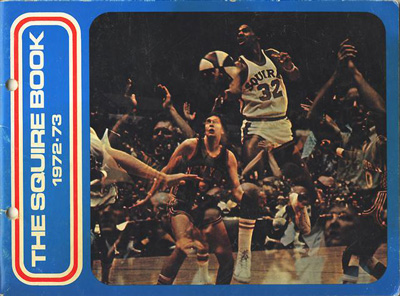
American Basketball Association (1970-1976)
Tombstone
Born: July 30, 1970 – The Washington Caps relocate to Virginia1Conference Slated On ABA Shift, UPI via The Dispatch, Jul. 29, 1970
Folded: May 10, 19762Virginia Franchise In ABA Terminated, AP via The Portsmouth Times, May 11, 1976
First Game: October 17, 1970 (W 133-116 vs. Pittsburgh Condors)
Last Game: April 7, 1976 (L 127-123 vs. New York Nets)
ABA Championships: None
Arenas
1970-1971: Old Dominion University Fieldhouse
Opened: 1970 3Chronology of Campus Building Development, ODU Libraries Online Exhibitions
Demolished: 20064Chronology of Campus Building Development, ODU Libraries Online Exhibitions
1971-1972: Roanoke Civic Center (10,100)51971-72 Sporting News American Basketball Association Official Guide
Opened: October, 1971
1970-1976: Hampton Coliseum (10,000)61975-76 Sporting News Official American Basketball Association Guide
Opened: December 1, 19697New Name in Spotlight After SC Cage Openers, AP via The Freelance Star, Dec. 2, 1969
1971-1976: Norfolk Scope (10,500)81975-76 Sporting News Official American Basketball Association Guide
Opened: November 12, 19719Norfolk Scope, 50 Years, The Virginia Pilot, Jul. 12, 2021
1971-1976: Richmond Coliseum (10,600)101975-76 Sporting News Official American Basketball Association Guide
Opened: August 24, 197111Ice revue will open Coliseum, The Free-Lance Star, Aug. 21, 1971
Closed: January 1, 201912Did you hear?-The Richmond Coliseum has closed- for now, WTVR, Channel 6, Richmond, VA, Feb. 2, 2019
Marketing
Team Colors:
Ownership
Owners:
- 1970-1974: Earl Foreman, et al.
- 1974: ABA
- 1974-1976: New Virginia Squires Inc. (Van Cunningham, Theodore Broecker, John Bernhardt, et al.)16Squires approved, new coach sought, UPI via The Daily Sentinel, Jun. 23, 1974
Background
The Virginia Squires began as the Oakland Oaks, co-owned by Pat Boone, off of singing.17ABA Ready For Action, UPI via The Beaver County Times, Feb. 3, 1967 They were charter members of the American Basketball Association (ABA) in 1967. Before their first season, they signed superstar Rick Barry, who had been playing across the bay for the then-San Francisco (now known as the Golden State) Warriors of the established National Basketball Association (NBA). A judge, however, blocked Barry from playing in the upstart league, so he sat out the 1967-68 season and joined the Oaks the following year.18Barry’s Stumping For New League, AP via The Meriden Journal, Oct. 10, 1967
In their inaugural season, the Oaks finished a league-worst 22-56 and, not surprisingly, bombed at the ticket window. With Barry on the team the following year, though, they wound up with the league’s best record at 60-18. The next best record belonged to the New Orleans Buccaneers with a mark of 46-32. The Oaks won the championship, but still averaged under 1,500 fans per game, even with Barry on the roster. Boone attended only 10 games that season due to television and touring commitments. He later joked that the championship ring he received as part-owner had cost him $2.5 million.
A capital idea
Seeking to cut his losses, the crooner and his partners sold the franchise to Washington, D.C.-area attorney Earl Foreman, 19ABA Report Sale Of Oaks To Earl Foreman, AP via The Victoria Advocate, Aug. 21, 1969who would later go on to form the Major Indoor Soccer League (MISL). In the fall of 1969, Foreman moved the Oaks to the nation’s capital and renamed them the Washington Caps. By this time, merger talks with the NBA had started. However, the ABA’s newest owner was proving to be the biggest obstacle to bringing the two sides together.
Baltimore Bullets’ owner Abe Pollin wanted to move his team to Washington. Foreman wanted to leave D.C. because the arena in which the Caps were playing, the Washington Coliseum, was in terrible shape and in a bad neighborhood, two factors that kept fans away.20NBA-ABA Merger Warms Up, AP via The Robesonian, Apr. 12, 1970 However, with the prospect of a merger, Foreman pretended he didn’t want to relocate his team and feigned stubbornness in order to get a better deal in the combined league.
Foreman did indeed get a great deal, including the promise of an NBA expansion franchise, but the merger fell through. Looking for a place to move his team, he decided to stay close to home and base his franchise in Virginia using the newly-built arenas in Norfolk, Hampton Roads, and Richmond. The plan was to operate the franchise, which he named the Squires, as a regional team. He made the announcement on July 30, 1970. The Bullets, incidentally, wouldn’t move for another two years as they waited for Capital Centre in Landover, MD, to be completed.
The initial move from California created another problem; star player Rick Barry didn’t want to leave California. He played in Washington that season, but then asked to buy out his contract so he could return to the Warriors, as he had seemingly left his heart there. Short on cash, Foreman opted for a deal to send Barry to the ABA’s New York Nets for $250,000 and a draft pick. Barry agreed, and the Virginia Squires moved on without him.21Squires Appease Virginia By Trading Barry To Nets, AP via The Herald-Journal, Sep. 3, 1970
Virginia is for basketball lovers
The newly christened team arrived in the Tidewater region of Virginia without their best player. However, led by Charlie Scott and George Carter, the Squires finished in first place in the ABA’s Eastern Division the following season. They lost in the conference finals to the Kentucky Colonels, but the franchise seemed to be moving in the right direction. Fans started showing up too, and while most crowds were in the 3,000-4,000 range, it was a vast improvement over Oakland and Washington. And things were about to get even better.
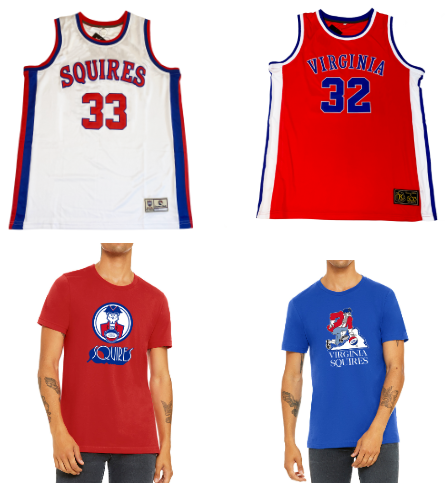
The NBA had a rule prohibiting teams from drafting players who were less than four years out of high school. The ABA had no such rule, and among the college underclassmen they signed was a very talented young man named Julius “Dr. J.” Erving, who inked a deal with the Squires.22UMass Player Erving Signs With Squires, AP via The Bangor Daily News, Apr. 6, 1971 The league already had a wide-open style which included the 3-point shot. Erving would bring added excitement to the ABA with his trademark slam dunks, a move frowned upon by the older NBA.
Doctor, Doctor
Erving was an immediate sensation, and the addition of George Gervin the following season made the Squires one of the league’s top teams, on the floor and at the gate, as they drew around 5,000 fans per game, very respectable by ABA standards. However, the team, like many in the league, continued to struggle financially. Erving was traded to the New York Nets in 1973.23Julius Erving Obtained by NY Nets, The Natchez News Leader, Aug. 12, 1973 With Barry gone back to the Warriors, Dr. J. still managed to turn the Nets into one of the league’s top teams. Gervin was shipped to San Antonio halfway through the following season for $225,000 and did the same for the Spurs.
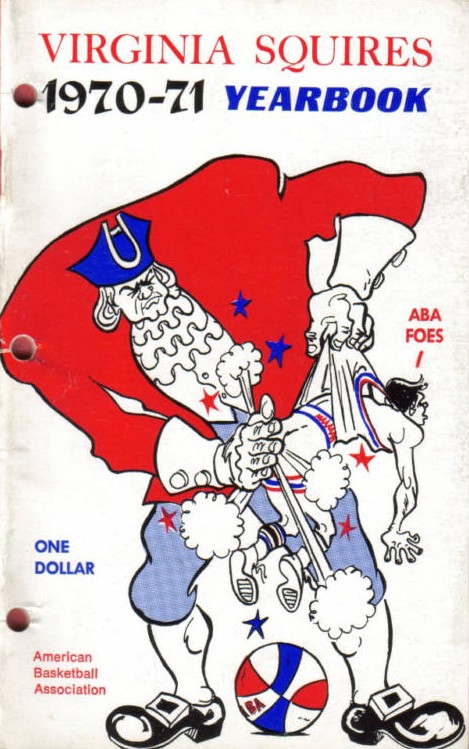 While the infusion of cash helped keep the team afloat in the short run, their record suffered, and fan support started to crumble. By the end of the 1973-74 season, attendance had fallen significantly, made worse by a 28-56 record and a last-place finish. As merger talks stopped and started, the Squires were just hoping to hang on long enough to join the NBA. They wouldn’t make it.
In February 1974, Foreman tried to sell the team to a group that owned the Tidewater Tides minor league baseball team, but that deal fell through.24Troubled Squires Sold To Norfolk-Backed Group, AP via The Herald-Journal, Feb. 9, 1974 The ABA took over the team briefly before selling it to a different Norfolk-based syndicate in June of that year.
NBA merger
As the 1975-76 season began, merger talks with the NBA heated up, and though they had the league’s worst record, the Squires drew over 10,000 for a December 15th contest against the Denver Nuggets. A full-page newspaper ad urging the team’s supporters to “save the Squires” helped.25Fans flock to ‘save the Squires, AP via The St. Joseph News-Press, Dec. 16, 1975 Fans realized their assistance was needed as the ABA’s seven remaining teams, including the Squires, hoped to join the older league within a year’s time. As the season drew to a close, though, the NBA made it clear that only four teams would be taken in. In May 1976, just a month before the final agreement was signed, the Squires folded after being unable to satisfy a financial assessment required for it to stay in the ABA. The Denver Nuggets, Indiana Pacers, New York Nets, and San Antonio Spurs joined the NBA for the 1976-77 season. The Kentucky Colonels and Spirits of St. Louis did not make the cut and disbanded.
The latter signed a famously clever deal in which they were paid a small percentage of the NBA’s TV revenue, based on the four former ABA clubs, in perpetuity. The NBA finally put an end to that agreement via a settlement in 2014.26Two Regular Brothers Netted $800 Million From The NBA In History’s ‘Greatest Sports Deal,’ yahoo!financeThe Squires, however, also made money after they disbanded, though not nearly as much as the Spirits’ former owners.
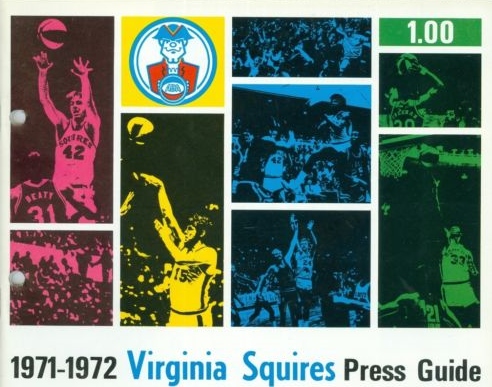 A 1981 out-of-court settlement required the surviving ABA teams to pay the Squires, still in existence, at least on paper, as the New Virginia Squires Inc., $60,000 per year for ten years, or $15,000 per year per team. Denver Nuggets president Carl Scheer was fuming.27Squires defunct but still making money, AP via The Free-Lance Star, Jul. 20, 1983
Over the years, Virginia, notably the Tidewater area (specifically, Norfolk, Hampton Roads, and Virginia Beach), the former home of the Squires, has been mentioned as a site for possible NBA expansion or relocation of an existing team. In 199728Hornets to Virginia, AP via The Robesonian, Jun. 8, 1997 and 200129Hornets eye Norfolk, VA, AP via The Beaver County Times, Dec. 14, 2001 the original Charlotte Hornets eyed the region. As recently as summer 2025, efforts to bring a team to The Old Dominion were afoot, primarily via a proposed arena in Virginia Beach.30With no experience, connections or money, he says he’ll finally bring an arena to Virginia Beach, The Virginia Mercury, Jul. 30, 2025 The NBA, however, as of this posting, has no plans to expand, nor are any teams currently looking to relocate.
Pat Boone interview, Good Seats Still Available podcast
One of our favorite episodes ever of Good Seats Still Available is this one with Pat Boone recounting his involvement as a part-owner of the Oakland Oaks.
Virginia Squires Shop
In Memoriam
Head Coach Al Bianchi (Squires ’70-’75) passed away on October 28, 2019 from congestive heart failure. Bianchi was 87 years old. New York Times obituary.
Links
###